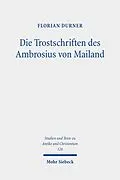
At the transition from pagan antiquity to Christian late antiquity, Ambrose of Milan attempts to make the challenge of dealing with death fruitful for the growing realm of Christianity. By presenting the shape and function of a "theology of consolation," Florian Durner contributes to an understanding of the fusion of pagan philosophy, rhetoric, and Christian theology.
At the transition from pagan antiquity to Christian late antiquity, people wrestled with different patterns of interpretation and means of consolation in the face of death. In this period, Ambrose of Milan represents an important voice attempting to make dying and consolation fruitful as a pastoral concern for the growing Christian community. Florian Durner traces this quest and examines Ambrose's innovative views on death, afterlife and resurrection in his writings. By interpreting the treatise "De bono mortis," which is discussed here in detail for the first time, the author shows how Ambrose integrates death into Christian existence contrary to Neoplatonist appropriation. Through the comprehensive presentation of the form and function of a "theology of consolation," Florian Durner contributes to an understanding of the fusion of pagan philosophy, rhetoric, and Christian theology in late antiquity.
Autorentext
Geboren 1987; Studium der Ev. Theologie, der lateinischen Philologie und der Erziehungswissenschaften in Erlangen, München und Rom; 2014-19 Promotionsstudent und wissenschaftlicher Mitarbeiter an der Theologischen Fakultät der Friedrich-Schiller-Universität Jena; 2019 Promotion; seit 2021 im Bayerischen Schuldienst.
At the transition from pagan antiquity to Christian late antiquity, people wrestled with different patterns of interpretation and means of consolation in the face of death. In this period, Ambrose of Milan represents an important voice attempting to make dying and consolation fruitful as a pastoral concern for the growing Christian community. Florian Durner traces this quest and examines Ambrose's innovative views on death, afterlife and resurrection in his writings. By interpreting the treatise "De bono mortis," which is discussed here in detail for the first time, the author shows how Ambrose integrates death into Christian existence contrary to Neoplatonist appropriation. Through the comprehensive presentation of the form and function of a "theology of consolation," Florian Durner contributes to an understanding of the fusion of pagan philosophy, rhetoric, and Christian theology in late antiquity.
Autorentext
Geboren 1987; Studium der Ev. Theologie, der lateinischen Philologie und der Erziehungswissenschaften in Erlangen, München und Rom; 2014-19 Promotionsstudent und wissenschaftlicher Mitarbeiter an der Theologischen Fakultät der Friedrich-Schiller-Universität Jena; 2019 Promotion; seit 2021 im Bayerischen Schuldienst.
Titel
Die Trostschriften des Ambrosius von Mailand
Untertitel
Consolatio mortis im Denken der Spätantike
Autor
EAN
9783161606670
Format
E-Book (pdf)
Hersteller
Genre
Digitaler Kopierschutz
Adobe-DRM
Dateigrösse
2.7 MB
Anzahl Seiten
418
Lesemotiv
Unerwartete Verzögerung
Ups, ein Fehler ist aufgetreten. Bitte versuchen Sie es später noch einmal.