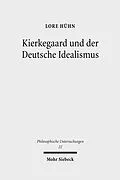
Lore Hühn examines Kierkegaard's existential philosophy which began with a critique of Hegel. This critique describes Kierkegaard's own transition into modernity.
Kierkegaard's existential philosophy began with a critique of Hegel. This critique describes Kierkegaard's own transition into modernity. To begin with, it converges with the path taken by Schelling in his later works, and at the same time it reinforces the late Fichte's approach to the practical self-realization of the individual. Kierkegaard radicalizes this approach and shows in great depth its fundamental religious and theological aspects. In this, the speculative figures of transition and suddenness are given a new Christological intelligibility, and at the same time those basic options which were the subject of controversy among the idealists become apparent.
"It is quite a task to untangle the web that somehow connects the Schelling, whose Naturphilosophie culminated in a break with his friend Fichte, to the Kierkegaard, whose remarkable dozen years of writing more or less begins in the period during which he is auditing Schelling's inaugural Berlin lectures. Such a task demands a fundamental rethinking of both the climate and the legacy of German idealism as such. I am happy to say that Lore Hühn's difficult but profound and surgically thorough and precise work [...] is impressively up to the task. [...] Dr. Hühn [...] one of the most thoughtful and illuminating readers of Schelling currently working in the Germanspeaking philosophical world" (S. 135).
Jason Wirth (Seattle University) in Research in Phenomenology 41 (201).
Autorentext
Geboren 1956; Studium der Philosophie, Germanistik und Politologie in Marburg und an der Freien Universität Berlin; 1993 Promotion; 2003 Habilitation; seit 2003 Professorin für Philosophie an der Albert-Ludwigs-Universität Freiburg; seit 2007 Präsidentin der Internationalen Schelling-Gesellschaft.
Kierkegaard's existential philosophy began with a critique of Hegel. This critique describes Kierkegaard's own transition into modernity. To begin with, it converges with the path taken by Schelling in his later works, and at the same time it reinforces the late Fichte's approach to the practical self-realization of the individual. Kierkegaard radicalizes this approach and shows in great depth its fundamental religious and theological aspects. In this, the speculative figures of transition and suddenness are given a new Christological intelligibility, and at the same time those basic options which were the subject of controversy among the idealists become apparent.
"It is quite a task to untangle the web that somehow connects the Schelling, whose Naturphilosophie culminated in a break with his friend Fichte, to the Kierkegaard, whose remarkable dozen years of writing more or less begins in the period during which he is auditing Schelling's inaugural Berlin lectures. Such a task demands a fundamental rethinking of both the climate and the legacy of German idealism as such. I am happy to say that Lore Hühn's difficult but profound and surgically thorough and precise work [...] is impressively up to the task. [...] Dr. Hühn [...] one of the most thoughtful and illuminating readers of Schelling currently working in the Germanspeaking philosophical world" (S. 135).
Jason Wirth (Seattle University) in Research in Phenomenology 41 (201).
Autorentext
Geboren 1956; Studium der Philosophie, Germanistik und Politologie in Marburg und an der Freien Universität Berlin; 1993 Promotion; 2003 Habilitation; seit 2003 Professorin für Philosophie an der Albert-Ludwigs-Universität Freiburg; seit 2007 Präsidentin der Internationalen Schelling-Gesellschaft.
Titel
Kierkegaard und der Deutsche Idealismus
Untertitel
Konstellationen des Übergangs
Autor
EAN
9783161513336
Format
E-Book (pdf)
Hersteller
Genre
Digitaler Kopierschutz
Adobe-DRM
Dateigrösse
1.75 MB
Anzahl Seiten
283
Lesemotiv
Unerwartete Verzögerung
Ups, ein Fehler ist aufgetreten. Bitte versuchen Sie es später noch einmal.