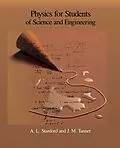
Physics for Students of Science and Engineering is a calculus-based textbook of introductory physics. The book reviews standards and nomenclature such as units, vectors, and particle kinetics including rectilinear motion, motion in a plane, relative motion. The text also explains particle dynamics, Newton's three laws, weight, mass, and the application of Newton's laws. The text reviews the principle of conservation of energy, the conservative forces (momentum), the nonconservative forces (friction), and the fundamental quantities of momentum (mass and velocity). The book examines changes in momentum known as impulse, as well as the laws in momentum conservation in relation to explosions, collisions, or other interactions within systems involving more than one particle. The book considers the mechanics of fluids, particularly fluid statics, fluid dynamics, the characteristics of fluid flow, and applications of fluid mechanics. The text also reviews the wave-particle duality, the uncertainty principle, the probabilistic interpretation of microscopic particles (such as electrons), and quantum theory. The book is an ideal source of reference for students and professors of physics, calculus, or related courses in science or engineering.
Inhalt
Preface
1 Introduction
1.1 Physics and the Scientific Method
1.2 Units
Standards and Nomenclature
Conversion of Units
1.3 Vectors
Vector and Scalar Quantitie
Vector Addition and Subtraction in Polar Form
Vector Multiplication
Rectangular Components of Vectors
Vector Operations in Component Notation
1.4 Problem-Solving: A Strategy
2 Particle Kinematics
2.1 Motion Along a Straight Line (Rectilinear Motion)
Position, Velocity, and Acceleration
Constant Acceleration in Rectilinear Motion
Free-Fail
2.2 Motion in a Plane
Position, Velocity, and Acceleration
Projectile Motion
Uniform Circular Motion
2.3 Relative Motion
2.4 Problem-Solving Summary
3 Force and Motion: Particle Dynamics
3.1 Newton's First Law
3.2 Newton's Second Law
3.3 Newton's Third Law
3.4 Weight and Mass
3.5 Applications of Newton's Laws
3.6 Problem-Solving Summary
4 Further Applications of Newton's Laws
4.1 Friction
4.2 Dynamics of Circular Motion
4.3 Law of Universal Gravitation
4.4 Static Equilibrium
Torque and Rotational Equilibrium
Center of Gravity
The Conditions of Static Equilibrium
4.5 Problem-Solving Summary
5 Work, Power, and Energy
5.1 Work
Work by a Constant Force
Work by a Variable Force
Work by an Arbitrary Force
5.2 Power
5.3 Energy
Kinetic Energy
The Work-Energy Principle
Potential Energy
5.4 Conservation of Energy
5.5 Conservative and Nonconservative Forces
5.6 Problem-Solving Summary
6 Momentum and Collisions
6.1 Center of Mass
6.2 Conservation of Linear Momentum
6.3 Collisions
Impulse
Classifying Collisions Energetically
Collisions in One Dimension
Collisions in Two Dimensions
6.4 Problem-Solving Summary
7 Rotational Motion
7.1 Rotation About a Fixed Axis
Rotational Kinematics
Rotational Energy and Moment of Inertia
Angular Momentum
Rotational Dynamics
7.2 Simultaneous Translation and Rotation
7.3 Conservation of Angular Momentum
7.4 Problem-Solving Summary
8 Oscillations
8.1 Simple Harmonic Motion
Kinematics of Simple Harmonic Motion
Dynamics of Simple Harmonic Motion
Energetics of Simple Harmonic Motion
8.2 Damped and Forced Oscillations
Damped Oscillations
Forced Oscillations: Resonance
8.3 Problem-Solving Summary
9 Mechanics of Fluids
9.1 The Fluid State
9.2 Fluid Statics
Fluid Pressure
Archimedes' Principle
Pascal's Law
9.3 Fluid Dynamics
Equation of Continuity and Bernoulli's Equation
Applications of Fluid Dynamics
9.4 Problem-Solving Summary
10 Heat and Thermodynamics
10.1 Thermal Equilibrium and Temperature
Temperature Scales
Thermal Expansion
10.2 Heat and Calorimetry
10.3 Thermodynamics
Thermodynamic States and Processes
The First Law of Thermodynamics
Heat Engines and the Second Law of Thermodynamics
The Carnot Cycle and the Absolute Temperature Scale
Entropy
10.4 Problem-Solving Summary
11 Electric Charge and Electric Fields
11.1 Electric Charge and Coulomb's Law
Induction
11.2 Electric Field
11.3 Motion of a Charged Particle in an Electric Field
11.4 Problem-Solving Summary
12 Calculation of Electric Fields
12.1 Electric Fields of Point Charges
12.2 Electric Fields of Continuous Charge Distributions
12.3 Electric Flux and Gauss's Law
12.4 Electrostatic Properties of Conductors
12.5 Problem-Solving Summary
13 Electric Potential
13.1 Electric Potential and Electric Fields
13.2 Electric Potential of Point Charges
13.3 Electric Potential of Continuous Charge Distributions
13.4 Equipotential Surfaces and Charged Conductors
13.5 Electrostatic Potential Energy of Charge Collections
13.6 Problem-Solving Summary
14 Capacitance, Current, and Resistance
14.1 Capacitance
Capacitance of Symmetrical Capacitors
Capacitors in Series and in Parallel
Effects ofDielectric Materials
14.2 Current and Resistance
Resistivity and Ohm's Law
Resistors and Combinations of Resistors
14.3 Energetics of Resistors and Capacitors
Electric Power Loss in Resistors
Energy Stored in Capacitors
14.4 Problem-Solving Summary
15 Direct-Current Circuits
15.1 Energy Reservoir in DC Circuits
15.2 Analysis of DC Circuits with Steady Currents
Kirchhoff's Rules
Ammeters and Voltmeters in DC Circuits
15.3 RC Circuits
15.4 Problem-Solving Summary
16 Magnetic Fields I
16.1 Magnetic Forces on Moving Charges
16.2 The Biot-Savart Law
16.3 Gauss's Law for Magnetic Fields and Ampere's Law
Gauss's Law for Magnetic Fields
Ampere's Law
16.4 Applications
16.5 Problem-Solving Summary
17 Magnetic Fields II
17.1 Induced Emf
Faraday's Law and Lenz' s Law
Motional Emf and Faraday's Law
17.2 Inductance
Inductors as Circuit Components
Energetics of Inductors
17.3 LR Circuits
17.4 Magnetic Media
Magnetic Properties of Matter
Ferromagnetism
17.5 Maxwell's Equations
17.6 Problem-Solving Summary
18 Electromagnetic Oscillations
18.1 Alternating-Current Circuits
Components in AC Circuits
Series RLC Circuits
Resonance in AC Circuits
Power and RMS Values in AC Circuits
18.2 Electromagnetic Radiation
18.3 The Electromagnetic Spectrum
18.4 Problem-Solving Summary
19 Wave Motion and Sound
19.1 Traveling Waves
19.1 Reflection, Superposition, and Standing Waves
19.3 Sound Waves
Pressure Waves and Superposition
Standing Sound Waves
Beats
The Doppler Effect
19.4 Sound and Human Hearing
19.5 Problem-Solving Summ…