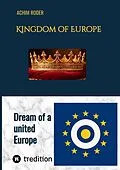
"Kingdom of Europe - A Story of Hope, Responsibility and the Venture of Democracy" is a utopian-political novel that sets out a peaceful, realistic vision for the future of Europe. Instead of dystopia and scenarios of decline, this work develops a positive, yet deliberately non-naive, scenario: it asks what might happen if Europe were to unite not out of fear of the world, but to re-found itself out of responsibility for it. At the centre of the plot is the political process of transforming today's European Union into a genuine European federal state: the "Kingdom of Europe". Yet, contrary to what the name might suggest, this is not about restoring monarchy in the traditional sense, but about a political metaphor. Monarchy here is symbolic - it stands for moderation, dignity, historical memory and the power to unite in an age of increasing complexity. The book begins with a moment of upheaval: a secret meeting in Rome at which leading European heads of state and government - including Markus Söder (Germany), Emmanuel Macron (France) and Keir Starmer (United Kingdom) - recognise the signs of the times. In a world of multiple crises - climate change, social division, technological upheaval and geopolitical tensions - they express the desire not merely to continue administering Europe, but to rethink it. From this impulse emerges a constitutional convention, whose opening in Oslo is presented as a foundational democratic moment. Representatives from politics, academia, civil society, youth and culture come together. They work publicly, in dialogue with the citizens of Europe, on a new constitution - the "Carta Europa". This is not about technocratic drafts, but about the great question: what holds Europe together? What must such a state guarantee? What can it do better than the old EU? The fundamental rights of the new state include not only classic freedoms and social protections, but also modern guarantees such as digital self-determination, climate justice, cultural diversity, participation beyond voting rights, and protection against algorithmic manipulation. The institutions are designed to be transparent, federal and participatory. A parliamentary democracy emerges, with direct citizen participation, an independent ethics council and a symbolic Crown Council, presided over by Charles III as the first constitutional monarch. The path into the new order does not come about through a sudden rupture, but through political processes, debates and compromises. The Kingdom of Europe is not created by revolution, but through evolutionary transformation. The old EU is left peacefully - with clear communication, respect and the promise of preserving neighbourly relations and cooperation. The book tells this process across 53 chapters. Chapter by chapter, the horizon widens: from the debates on fundamental rights in Oslo, to the introduction of the common currency "Euro-E", the establishment of a European central police force, new education and healthcare structures, and the accession of further states such as Denmark, Iceland, Italy, Greece, Portugal and Cyprus. A new cultural and geopolitical frame of reference also emerges: Europe develops a space programme, its own satellite system, a digital common-good internet and a transnational university.
Autorentext
Achim Roder wurde 1945 in Oberstdorf geboren und lebt heute in Niederbayern, wo er zwei Apotheken betreibt. Nach seinem Pharmaziestudium arbeitete er zunächst als Krankenhausapotheker in Straubing. Von 1975 bis 1979 war er Mitglied des Ausschusses "Normen und Verpackung" der Arbeitsgemeinschaft Deutscher Krankenhausapotheker. In dieser Zeit begann er, sich intensiv mit den Auswirkungen der aufkommenden Kostendämpfungspolitik im Gesundheitswesen auseinanderzusetzen - ein Thema, das ihn bis heute begleitet. Ein prägender Moment war der Deutsche Apothekertag in München Mitte der 1970er Jahre. Dort meldete er sich mit einer kritischen Stellungnahme gegenüber dem damaligen Bundesarbeits- und Sozialminister Walter Arendt (SPD) zu Wort. Er warf der Gesundheitspolitik vor, betriebswirtschaftliche Prinzipien über das Wohl der Patienten zu stellen, und prophezeite die Abwanderung der pharmazeutischen Industrie aus Deutschland. Diese Haltung galt damals als provokant, stieß jedoch auf breite Zustimmung unter Fachkollegen. 1979 wurde er in den Vorstand der Bayerischen Landesapothekerkammer gewählt und gründete im selben Jahr seine erste Apotheke. 2008 kam eine zweite Apotheke hinzu, die er seither ebenfalls betreibt. Darüber hinaus war er zeitweise im gesundheitspolitischen Ausschuss der CSU tätig. Als approbierter Apotheker veröffentlichte er im Deutschen Apothekerverlag das Fachbuch "Herstellungs- und Haltbarkeitsdaten Deutscher Arzneimittel", das sich als verlässliches Nachschlagewerk etabliert hat. Königreich Europa ist sein erstes belletristisches Werk - ein literarisch-politisches Projekt, das aus der Überzeugung entstanden ist, dass Sprache nicht nur beschreibt, sondern gestaltet. Der Roman verknüpft persönliche Lebenserfahrung mit gesellschaftlicher Reflexion und formuliert eine mutige Vision für ein neues Europa - getragen von Verantwortung, kritischem Geist und dem Glauben an die Kraft des Wortes.