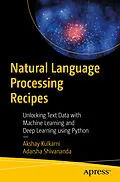
- Apply NLP techniques using Python libraries such as NLTK, TextBlob, spaCy, Stanford CoreNLP, and many more
- Implement the concepts of information retrieval, text summarization, sentiment analysis, and other advanced natural language processing techniques.
- Identify machine learning and deep learning techniques for natural language processing and natural language generation problems
Autorentext
Akshay Kulkarni is an AI and machine learning evangelist. Akshay has a rich experience of building and scaling AI and machine learning businesses and creating significant client impact. He is currently the senior data scientist at SapientRazorfish's core data science team where he is part of strategy and transformation interventions through AI and works on various machine learning, deep learning and artificial intelligence engagements by applying state-of-the-art techniques in this space. Previously he was part of Gartner and Accenture, where he scaled the analytics and data science business.
He is a regular speaker at major data science conferences. He is a visiting faculty for some of the top graduate institutes in India. In his spare time, he enjoys reading, writing, coding, and helping aspiring data scientists. He lives in Bangalore with his family.
Adarsha Shivananda is a senior data scientist at Indegene's product and technology team where he is working on building machine learning and AI capabilities for pharma products. He is aiming to build a pool of exceptional data scientists within and outside of the organization to solve greater problems through brilliant training programs and always wants to stay ahead of the curve. Previously he worked with Tredence Analytics and IQVIA. Adarsha has worked extensively in the pharma, healthcare, retail, and marketing domains.
He lives in Bangalore and loves to read, ride, and teach data science.
Inhalt
Chapter 1: Extracting the data
Chapter Goal: Understanding the potential data sources to build natural language processing applications for business benefits and ways to extract the data with examples
No of pages: 20
Sub - Topics:
1. Data extraction through API
2. Web scraping
3. Regular expressions
4. Handling strings
Chapter 2: Exploring and processing text data
Chapter Goal: Data is never clean. This chapter will give in depth knowledge about how to clean and process the text data. It also cover tokenizing and parsing.
No of pages: 15
Sub - Topics
1. Text preprocessing methods using python
1. Data cleaning
2. Lexicon normalization
3. Tokenization
4. Parsing and regular expressions
5. Exploratory data analysis
Chapter 3: Text to features
Chapter Goal: One of the important task with text data is to transform text data into machines or algorithms understandable form, by using different feature engineering methods
No of pages: 20
Sub - Topics
1. Feature engineering using python
o One hot encoding
o Count vectorizer
o TF-IDF
o Word2vec
o N grams
Chapter 4: Advanced natural language processing
Chapter Goal: A comprehensive understanding of key concepts, methodologies and implementation of natural language processing techniques.
No of pages: 40
Sub - Topics:
1. Text similarity
2. Information extraction NER
3. Topic modeling
4. Machine learning for NLP
a. Text classification
b. Sentiment Analysis
5. Deep learning for NLP-
a. Seq2seq,
b. Sequence prediction using LSTM and RNN
6. Summarizing text
Chapter 5: Industrial application with end to end implementation
Chapter Goal: Solving real time NLP applications with end to end implementation using python. Right from framing and understanding the business problem to deploying the model.
No of pages: 40
Sub - Topics:
1. Consumer complaint classification
2. Customer reviews sentiment prediction
3. Data stitching using text similarity and record linkage
4. Text summarization for subject notes
5. Document clustering
6. Architectural details of Chatbot and Search Engine along with Learning to rank
Chapter 6: Deep learning for NLP
Chapter Goal: Unlocking the power of deep learning on text data. Solving few real-time applications of deep learning in NLP.
No of pages: 40
Sub - Topics:
1. Fundamentals of deep learning
2. Information retrieval using word embedding's
3. Text classification using deep learning approaches (CNN, RNN, LSTM, Bi-directional LSTM)
4. Natural language generation prediction next word/ sequence of words using LSTM.
5. Text summarization using LSTM encoder and decoder.