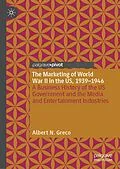
From the late 1930s until December 7, 1941, isolationism and an antipathy toward war in Europe were strong political currents in the US. However, once the US entered World War II, the entire apparatus of the US government was mobilized to "market" the war to Americans who were incredulous and horrified about the attack at Pearl Harbor. Americans wanted immediate and detailed information from the US government and the nation's media and entertainment companies about the recent military disasters. This book analyzes the complex relationships between the US government and the entire media and entertainment industries between 1939 and 1946.
The US government realized in early 1942 that it needed to forge an alliance with the media and entertainment industries to create and maintain support for the war. The Office of War Information (OWI) was the US government agency acting as the liaison between Washington and the diverse media and entertainment industries; and all of them confronted a series of major issues and concerns to convince Americans to support the war effort. This book offers business historians an examination of the complex and sometimes tense relationships between the OWI and the radio, magazine, newspaper, and motion picture industries.
Autorentext
Albert N. Greco is Professor of Marketing at the Gabelli School of Business at Fordham University, USA. He has authored or edited nearly 30 books, mostly in relation to the book and scholarly journal industries, though he has also written extensively on the newspaper, magazine, information, and radio sectors.
Inhalt
Introduction: The U.S. Government And American Society: 1939-1941.
1. Isolationism in the U.S. 1939-1941:
· the impact of major losses during World War I and the devastating impact of the Great Depression created a strong current of isolationism in the U.S.;
· the outbreak of World War II on September 1, 1939 exacerbated the situation, especially in the U.S. Congress;
· President Roosevelt had to address isolationism and the need to support England during a period of major German successes, leading to the Lend-Lease program, etc.2. Detailed analysis of the key U.S. Government departments and agencies (e.g., The War Department):
3. Detailed analysis of key economic indices (e.g., the Gross Domestic Product; interest rates; unemployment rates; per capita income; U.S. government revenues and expenditures; etc.) as they approached the outbreak of war.
4. Detailed analysis of the U.S. media and the entertainment industries (e.g., circulation and attendance at events; revenues and expenditures; etc. ) as they
approached the outbreak of war.
Chapter 1: After Pearl Harbor: The U.S. Government and the Media and Entertainment Industries: December 1941-to Mid-1942.
1. The mission, activities, and goals of the Office of War Information (OWI; est. June 13, 1942; Executive Order 9182):
· analysis of Executive Order 9182 and the mission-strategies and organizational structure of OWI: personnel; budget; outreach activities to the communications and entertainment industries;
· analysis of the early activities of OWI (e.g., radio shows; Voice of America; This Is Our Enemy; etc.); OWI Bureau of Motion Pictures (liaison with the War Department; the Office of Strategic Services, OSS; etc.); newspapers and foreign war reporters; magazines and depiction of life during the war;
2. The initial mission, activities, and goals of other U.S. Government departments and agencies
· initial attempts to finance wartime spending and domestic borrowing
· wage controls;
· the state of the U.S. economy; etc.· campaigns to generate support for price controls, rationing, mobilization, etc.;
· the U.S. Government's realization in early 1942 that they needed to forge an alliance with the media and entertainment industries to create and maintain support for the war.
Chapter 2: 1942-1945: The U.S. Government and Book Publishers Confront the War
1. The state of the U.S. book publishing industry in 1942
· number of publishing firms· new title output (statistical data from the R.R. Bowker Company; N.B.: paper was rationed during World War II):
1939: 10,640;