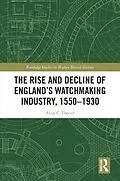
This survey of the rise and decline of English watchmaking fills a gap in the historiography of British industry. Clerkenwell in London was supplied with 'rough movements' from Prescot, 200 miles away in Lancashire. Smaller watchmaking hubs later emerged in Coventry, Liverpool, and Birmingham. The English industry led European watchmaking in the late eighteenth century in output, and its lucrative export markets extended to the Ottoman Empire and China. It also made marine chronometers, the most complex of hand-crafted pre-industrial mechanisms, crucially important to the later hegemony of Britain's navy and merchant marine. Although Britain was the 'workshop of the world', its watchmaking industry declined. Why? First, because cheap Swiss watches were smuggled into British markets. Later, in the era of Free Trade, they were joined by machine-made watches from factories in America, enabled by the successful application to watch production of the 'American system' in Waltham, Massachusetts after 1858. The Swiss watch industry adapted itself appropriately, expanded, and reasserted its lead in the world's markets. English watchmaking did not: its trajectory foreshadowed and was later followed by other once-prominent British industries. Clerkenwell retained its pre-industrial production methods. Other modernization attempts in Britain had limited success or failed.
Autorentext
Alun C. Davies, Ph.D., was educated at the Universities of Aberystwyth and Princeton and retired in 1999 after thirty-three years at The Queen's University of Belfast as Reader (and sometime Head of Department) in the Department of Economic and Social History.
Inhalt
Part 1: Rise
1. Origins: From Craft to Industry
2. Supply: Clerkenwell and Prescot: A Geographical Division of Labour
3; Supply: Two Other Hubs: Liverpool and Coventry
4. Towards English Horology's Golden Age: Technology, Organisation, Rewards
5. Demand: Domestic, Government, and Foreign
Part 2: Challenge
6. Clouds on the Horizon: Switzerland's Challenge
7. War and Peace, 1793-1817: Crisis, Recovery, and Crisis Again
8. The 1817 Inquiry: Tariffs and Smuggling, 1818-1842
9. The Ingold Episode and After, 1842-1860
10. Meeting the Challenge: Chronometers in War and Peace, 1793-1860
Part 3: Decline
11. Revolution in America: Evolution in Switzerland
12. Consequences for Britain
13. The British Horological Institute: Ignoring the Elephant
14. Twilight in Clerkenwell: Ignoring the Market
15. Attempting the "American System": Birmingham, Coventry and Liverpool
16. English Chronometers Defy Decline
17. The Great War and After
Postscript: The Third Horological Era