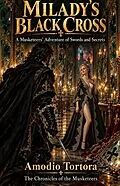
Paris, during the reign of Louis XIII, in the uneasy calm following one of the most delicate intrigues ever to shake the court. It is a peace that resembles rest less than the breath held before a blow. The King still distrusts his nobles, the Queen walks a narrow line between honor and suspicion, and Cardinal Richelieu weaves his web with implacable patience by the light of a single candle. The King's Musketeers believe they have already witnessed the worst their age can offer. They are about to discover how profoundly mistaken they are.
One rainy night, in the courtyard of the Louvre, an officer of the Musketeers is found dying. A small cross has been traced upon his chest, not with ink, but with a corrosive liquid that has slowly eaten into his living flesh. Before he expires, he utters three words that freeze the blood of those who hear them: the announcement of a shadow returned from the past. D'Artagnan immediately thinks of an old enemy; Athos, who knows that adversary better than any other living man, retreats into a silence colder than the rain, for he understands a terrible law: whenever she reveals herself, it is always a sign that someone has already been chosen to die.
What follows is a trap constructed with years of patience. A forged letter, written in a hand no one could distinguish from that of Athos, falls into the Cardinal's possession, and the Count de La Fère is conducted, quietly, almost courteously, to a secret prison, while a mind colder than Richelieu's waits to see what his three friends will do. D'Artagnan seizes his sword; Porthos dreams of a plan of fire and assault; Aramis alone counsels patience, sensing that an invisible hand seeks to scatter the four and induce them to destroy themselves through their own sense of honor.
The confession of a dying man, brought to Aramis by an elderly friar, names the true enemy: a clandestine brotherhood called the Black Cross, born amid the wars of religion and surviving as a network of spies, blackmailers, and assassins, now gathered beneath a single will, blond and merciless, intent on holding in one hand the secret disgraces of three kingdoms. Against this design, the four are drawn, each along a separate path perfectly tailored to his particular weakness: Porthos toward a wealthy, admiring widow and a private convoy that is not at all what it seems; Aramis toward a weeping Spanish novice who has seen too much; d'Artagnan along a trail of witnesses murdered an instant before he can reach them, mocked at every turn by a masked figure who fights him not with steel but with the truth about himself. And Athos plays the most dangerous game of all, allowing himself to be believed a traitor so that he may walk, alone and stripped of his own name, into the heart of the enemy's house.
The roads converge upon a half-ruined castle in the chalk country of Champagne, where discontented nobles, hired German swordsmen, foreign agents, and the withered fanatics of the old wars gather around something they call the Iron Testament, a treasure trove of names capable of setting half of Europe ablaze. There, in a single night of music, masks, and blades silently drawn, the four friends arrive, each beneath a different disguise and a different lie, and the long, patient design tightens around them all.
A tale of cloaks, swords, and courtly intrigue in the grand tradition, yet threaded with a graver current beneath the candlelight and the clash of steel: a study of guilt, of the strange and ruinous bond between those who have wronged one another beyond all forgiveness, and of the price honest men must pay to pass, for a single night, through a world that operates entirely upon secrets.