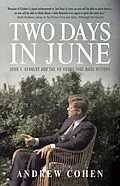
June 1963. John Fitzgerald Kennedy has been president of the United States for almost two and a half years. That spring he is at a tipping point, grappling with the two seismic forces of his time: nuclear arms and civil rights. On two consecutive days, in two lyrical addresses, he asks Americans
to abandon their prejudices in the shadow of the Cold War and Jim Crow. The first leads to the Limited Nuclear Test Ban Treaty of 1963, the second to the Civil Rights Act of 1964.
Two Days in June captures Kennedy at the high noon of his presidency. Based on unseen documentary footage, JFK's feverish forty-eight hours unspool in suspenseful clarity. In this tick-tock of the presidency, we see him everywhere from facing down George Wallace over the integration of the University of Alabama to talking obsessively about sex and politics at a dinner party in Georgetown.
There were 1,036 days in the presidency of John F. Kennedy. This is the story of two of them.
Autorentext
ANDREW COHEN is an award-winning journalist and former Washington correspondent whom the New York Times has called "one of Canada's most distinguished authors." A native of Montreal, he attended Choate Rosemary Hall, McGill University, and the University of Cambridge. Among his bestselling books are The Unfinished Canadian: The People We Are; Trudeau's Shadow: The Life and Legacy of Pierre Elliott Trudeau (with J.L. Granatstein); Extraordinary Canadians: Lester B. Pearson; and While Canada Slept: How We Lost Our Place in the World, a finalist for the Governor General's Literary Award for Non-fiction. He has written for United Press International, Time, The Globe and Mail, The Financial Post, and The Financial Times of London from Washington, London, Berlin, Toronto, and Ottawa. He has won two National Newspaper Awards, three National Magazine Awards, and the Queen's Diamond Jubilee Medal. A professor of journalism and international affairs at Carleton University, Cohen writes a nationally syndicated column for the Ottawa Citizen.