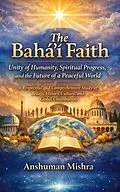
In an era marked by rapid technological change, global interconnectedness, cultural diversity, and a shared search for ethical clarity, humanity increasingly turns toward spiritual traditions that emphasize unity, dignity, justice, and collective progress. The Bahá'í Faith: Unity of Humanity, Spiritual Progress, and the Future of a Peaceful World is a comprehensive, respectful, and academically grounded exploration of the Bahá'í Faith, presenting it as a living spiritual path devoted to the oneness of humanity and the advancement of global harmony.
This book has been written with great care, responsibility, and cultural sensitivity. It does not engage in comparison, debate, judgment, or criticism of any religion, belief system, philosophy, or worldview. Instead, it focuses exclusively on presenting the Bahá'í Faith in its own voice?highlighting its origins, teachings, values, institutions, culture, festivals, sacred places, global community, and contributions to human civilization. The purpose of this work is educational, reflective, and constructive: to foster understanding, respect, and appreciation through knowledge.
At its heart, the Bahá'í Faith offers a vision of humanity as a single family, bound together by shared spiritual origins and a common destiny. This book explains how unity is not presented merely as an ideal, but as a practical principle guiding personal conduct, community life, social organization, and global cooperation. Through clear explanations and structured chapters, readers are introduced to how the Bahá'í teachings address fundamental questions of meaning, purpose, ethics, justice, and progress?without dogma, hostility, or exclusion.
The opening chapters provide a clear and accessible introduction to the historical emergence of the Bahá'í Faith in the nineteenth century, placing its development within its historical and cultural context. The life and mission of Bahá'u'lláh, the Founder of the Bahá'í Faith, are presented respectfully, emphasizing his teachings on unity, peace, moral responsibility, and spiritual education. The book explains how sacred writings play a central role in shaping ethical life, social responsibility, and spiritual awareness within the Bahá'í community.
A major strength of this work lies in its detailed yet approachable explanation of the core beliefs of the Bahá'í Faith. These include the oneness of humanity, the importance of justice, the equality of women and men, the harmony between spiritual values and rational inquiry, the dignity of work and service, and the transformative power of education. Each principle is explained in a positive, academic manner, showing how these teachings are intended to inspire ethical living and collective well-being.
The book also offers an in-depth exploration of spiritual life and personal development. It explains the role of prayer, reflection, moral discipline, and lifelong learning as tools for inner growth and social contribution. Rather than presenting spirituality as withdrawal from the world, the Bahá'í Faith is shown as encouraging active engagement with society, guided by compassion, responsibility, and integrity.
An important section of the book is dedicated to the unique administrative and institutional structure of the Bahá'í Faith. Readers are introduced to a system based on consultation, collective decision-making, and service-oriented leadership, without a professional clergy. The emphasis is placed on ethical governance, unity in diversity, and participation at local, national, and international levels. This structure is presented not as a political model, but as a spiritual framework designed to support harmony and cooperation.