Computational properties of use to biological organisms or to the construction of computers can emerge as collective properties of systems having a large number of simple equivalent components (or neurons). The physical meaning of content-addressable memory is described by an appropriate phase space flow of the state of a system. A model of such a system is given, based on aspects of neurobiology but readily adapted to integrated circuits. The collective properties of this model produce a content-addressable memory which correctly yields an entire memory from any subpart of sufficient size. The algorithm for the time evolution of the state of the system is based on asynchronous parallel processing. Additional emergent collective properties include some capacity for generalization, familiarity recognition, categorization, error correction, and time sequence retention. The collective properties are only weakly sensitive to details of the modeling or the failure of individual devices.
Autorentext
Hey, Anthony
Zusammenfassung
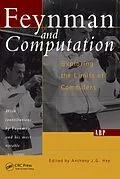
Richard P. Feynman made profoundly important and prescient contributions to the physics of computing, notably with his seminal articles ?There's Plenty of Room at the Bottom? and ?Simulating Physics with Computers.? These two provocative papers (both reprinted in this volume) anticipated, decades before their time, several breakthroughs that have since become fields of science in their own right, such as nanotechnology and the newest, perhaps most exciting area of physics and computer science, quantum computing.The contributors to this book are all distinguished physicists and computer scientists, and many of them were guest lecturers in Feynman's famous CalTech course on the limits of computers. they include Charles Bennett on Quantum Information Theory, Geoffrey Fox on Internetics, Norman Margolus on Crystalline Computation, and Tommaso Toffoli on the Fungibility of Computation.Both a tribute to Feynman and a new exploration of the limits of computers by some of today's most influential scientists, Feynman and Computation continues the pioneering work started by Feynman and published by him in his own Lectures on Computation. This new computation volume consists of both original chapters and reprints of classic papers by leaders in the field. Feynman and Computation will generate great interest from the scientific community and provide essential background for further work in this field.
Inhalt
Feynman and Computation -- Feynman's Course on Computation -- Feynman and Computation -- Neural Networks and Physical Systems with Emergent Collective Computational Abilities -- Feynman as a Colleague -- Collective Electrodynamics I -- A Memory -- Numerical Evidence that the Motion of Pluto is Chaotic -- Reducing the Size -- There's Plenty of Room at the Bottom -- Information is Inevitably Physical -- Scaling of MOS Technology to Submicrometer Feature Sizes -- Richard Feynman and Cellular Vacuum -- Quantum Limits -- Simulating Physics with Computers -- Quantum Robots -- Quantum Information Theory -- Quantum Computation -- Parallel Computation -- Computing Machines in the Future -- Internetics: Technologies, Applications and Academic Fields -- Richard Feynman and the Connection Machine -- Crystalline Computation -- Fundamentals -- Information, Physics, Quantum: The Search for Links -- Feynman, Barton and the Reversible Schrödinger Difference Equation -- Action, or the Fungibility of Computation -- Algorithmic Randomness, Physical Entropy, Measurements, and the Demon of Choice