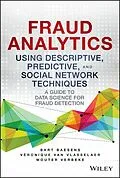
Detect fraud earlier to mitigate loss and prevent cascading damage Fraud Analytics Using Descriptive, Predictive, and Social Network Techniques is an authoritative guidebook for setting up a comprehensive fraud detection analytics solution. Early detection is a key factor in mitigating fraud damage, but it involves more specialized techniques than detecting fraud at the more advanced stages. This invaluable guide details both the theory and technical aspects of these techniques, and provides expert insight into streamlining implementation. Coverage includes data gathering, preprocessing, model building, and post-implementation, with comprehensive guidance on various learning techniques and the data types utilized by each. These techniques are effective for fraud detection across industry boundaries, including applications in insurance fraud, credit card fraud, anti-money laundering, healthcare fraud, telecommunications fraud, click fraud, tax evasion, and more, giving you a highly practical framework for fraud prevention. It is estimated that a typical organization loses about 5% of its revenue to fraud every year. More effective fraud detection is possible, and this book describes the various analytical techniques your organization must implement to put a stop to the revenue leak. * Examine fraud patterns in historical data * Utilize labeled, unlabeled, and networked data * Detect fraud before the damage cascades * Reduce losses, increase recovery, and tighten security The longer fraud is allowed to go on, the more harm it causes. It expands exponentially, sending ripples of damage throughout the organization, and becomes more and more complex to track, stop, and reverse. Fraud prevention relies on early and effective fraud detection, enabled by the techniques discussed here. Fraud Analytics Using Descriptive, Predictive, and Social Network Techniques helps you stop fraud in its tracks, and eliminate the opportunities for future occurrence.
Autorentext
BART BAESENS is a full professor at KU Leuven, and a lecturer at the University of Southampton. He has done extensive research on analytics, customer relationship management, web analytics, fraud detection, and credit risk management. He regularly advises and provides consulting support to international firms with respect to their analytics and credit risk management strategy.
VÉRONIQUE VAN VLASSELAER is a PhD researcher in the Department of Decision Sciences and Information Management at KU Leuven. Her research focuses on the development of new techniques for fraud detection by combining predictive and network analytics.
WOUTER VERBEKE is an assistant professor at Vrije Universiteit Brussel (Brussels, Belgium). His research is situated in the field of predictive analytics and complex network analysis with applications in fraud, marketing, credit risk, human resources management, and mobility.
Klappentext
Detect fraud earlier to mitigate loss and prevent cascading damage
Fraud Analytics Using Descriptive, Predictive, and Social Network Techniques is an authoritative guidebook for setting up a comprehensive fraud detection analytics solution. Early detection is a key factor in mitigating fraud damage, but it involves more specialized techniques than detecting fraud at the more advanced stages. This invaluable guide details both the theory and technical aspects of these techniques, and provides expert insight into streamlining implementation. Coverage includes data gathering, preprocessing, model building, and post-implementation, with comprehensive guidance on various learning techniques and the data types utilized by each. These techniques are effective for fraud detection across industry boundaries, including applications in insurance fraud, credit card fraud, anti-money laundering, healthcare fraud, telecommunications fraud, click fraud, tax evasion, and more, giving you a highly practical framework for fraud prevention.
It is estimated that a typical organization loses about 5% of its revenue to fraud every year. More effective fraud detection is possible, and this book describes the various analytical techniques your organization must implement to put a stop to the revenue leak.
* Examine fraud patterns in historical data
* Utilize labeled, unlabeled, and networked data
* Detect fraud before the damage cascades
* Reduce losses, increase recovery, and tighten security
The longer fraud is allowed to go on, the more harm it causes. It expands exponentially, sending ripples of damage throughout the organization, and becomes more and more complex to track, stop, and reverse. Fraud prevention relies on early and effective fraud detection, enabled by the techniques discussed here. Fraud Analytics Using Descriptive, Predictive, and Social Network Techniques helps you stop fraud in its tracks, and eliminate the opportunities for future occurrence.
Zusammenfassung
Detect fraud earlier to mitigate loss and prevent cascading damage
Fraud Analytics Using Descriptive, Predictive, and Social Network Techniques is an authoritative guidebook for setting up a comprehensive fraud detection analytics solution. Early detection is a key factor in mitigating fraud damage, but it involves more specialized techniques than detecting fraud at the more advanced stages. This invaluable guide details both the theory and technical aspects of these techniques, and provides expert insight into streamlining implementation. Coverage includes data gathering, preprocessing, model building, and post-implementation, with comprehensive guidance on various learning techniques and the data types utilized by each. These techniques are effective for fraud detection across industry boundaries, including applications in insurance fraud, credit card fraud, anti-money laundering, healthcare fraud, telecommunications fraud, click fraud, tax evasion, and more, giving you a highly practical framework for fraud prevention.
It is estimated that a typical organization loses about 5% of its revenue to fraud every year. More effective fraud detection is possible, and this book describes the various analytical techniques your organization must implement to put a stop to the revenue leak.
- Examine fraud patterns in historical data
- Utilize labeled, unlabeled, and networked data
- Detect fraud before the damage cascades
- Reduce losses, increase recovery, and tighten security
The longer fraud is allowed to go on, the more harm it causes. It expands exponentially, sending ripples of damage throughout the organization, and becomes more and more complex to track, stop, and reverse. Fraud prevention relies on early and effective fraud detection, enabled by the techniques discussed here. Fraud Analytics Using Descriptive, Predictive, and Social Network Techniques helps you stop fraud in its tracks, and eliminate the opportunities for future occurrence.
Inhalt
List of Figures xv
Foreword xxiii
Preface xxv
Acknowledgments xxix
Chapter 1 Fraud: Detection, Prevention, and Analytics! 1
Introduction 2
Fraud! 2
Fraud Detection and Prevention 10
Big Data for Fraud Detection 15
Data-Driven Fraud Detection 17
Fraud-Detection Techniques 19
Fraud Cycle 22
The Fraud Analytics Process Model 26
Fraud Data Scientists 30
A Fraud Data Scientist Should Have Solid Quantitative Skills 30
A Fraud Data Scientist Should Be a Good Programmer 31
A Fraud Data Scientist Should Excel in Communication and Visualization Skills 31
A Fraud Data Scientist Should Have a Solid Business Understanding 32
A Fraud Data Scientist Should Be Creative 32
A Scientific Perspective on Fraud 33
Reference…