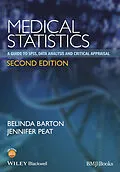
Medical Statistics provides the necessary statistical tools to enable researchers to undertake and understand evidence-based clinical research.
It is a practical guide to conducting statistical research and interpreting statistics in the context of how the participants were recruited, how the study was designed, what types of variables were used, what effect size was found, and what the P values mean. It guides researchers through the process of selecting the correct statistics and show how to best report results for presentation and publication.
Clear and concise explanations, combined with plenty of examples and tabulated explanations are based on the authors' popular medical statistics courses.
The table of contents is divided into sections according to whether data are continuous or categorical in nature as this distinction is fundamental to selecting the correct statistics. Each chapter provides a clear step-by-step guide to each statistical test with practical instructions on how to generate and interpret the numbers, and present the results as scientific tables or graphs. The chapters conclude with critical appraisal guidelines to help researchers review the reporting of results from each type of statistical test.
This new edition includes a new chapter on repeated measures and mixed models and a helpful glossary of terms provides an easy reference that applies to all chapters.
Autorentext
Belinda Barton, Head and Psychologist, Children's Hospital Education Research Institute (CHERI), Conjoint Senior Lecturer, Sydney Medical School, University of Sydney, NSW Australia.
Jennifer Peat, Associate Professor, Department of Paediatrics and Child Health and Senior Hospital Statistician, Clinical Epidemiology Unit, Children's Hospital, Westmead, NSW Australia.
Klappentext
Medical Statistics provides you with the essential knowledge and skills to undertake and understand evidence-based clinical research. This book is invaluable for researchers and clinicians engaged in a wide range of research studies. A practical, comprehensive, stepby-step guide is provided - from study design, required sample size, selecting the correct statistical test, checking test assumptions, conducting and interpreting statistics, interpretation of effect sizes and P values, to how best report results for presentation and publication.
The SPSS commands for methods of statistical analyses frequently conducted in the health care literature are included such, as t-tests, ANOVA, regression, survival analysis, diagnostic and risk statistics etc. In addition, the most relevant corresponding output and interpretation is presented, with clear and concise explanations. Each chapter includes worked research examples with real data sets that can be downloaded. Critical appraisal checklists are also included to help researchers systemically evaluate the results of studies. This new edition includes a new chapter on longitudinal data that includes both a repeated measures and mixed models approach. Furthermore, all commands and output have been updated to IBM Statistics SPSS version 21 and SigmaPlot version 12.5.
Data sets for this book can be downloaded from
www.wiley.com/go/barton/medicalstatistics2e
Zusammenfassung
Medical Statistics provides the necessary statistical tools to enable researchers to undertake and understand evidence-based clinical research.
It is a practical guide to conducting statistical research and interpreting statistics in the context of how the participants were recruited, how the study was designed, what types of variables were used, what effect size was found, and what the P values mean. It guides researchers through the process of selecting the correct statistics and show how to best report results for presentation and publication.
Clear and concise explanations, combined with plenty of examples and tabulated explanations are based on the authors' popular medical statistics courses.
The table of contents is divided into sections according to whether data are continuous or categorical in nature as this distinction is fundamental to selecting the correct statistics. Each chapter provides a clear step-by-step guide to each statistical test with practical instructions on how to generate and interpret the numbers, and present the results as scientific tables or graphs. The chapters conclude with critical appraisal guidelines to help researchers review the reporting of results from each type of statistical test.
This new edition includes a new chapter on repeated measures and mixed models and a helpful glossary of terms provides an easy reference that applies to all chapters.
Inhalt
Introduction, ix
Acknowledgements, xiii
About the companion website, xv
Chapter 1 Creating an SPSS data file and preparing to analyse the data, 1
1.1 Creating an SPSS data file, 1
1.2 Opening data from Excel in SPSS, 6
1.3 Categorical and continuous variables, 7
1.4 Classifying variables for analyses, 7
1.5 Hypothesis testing and P values, 8
1.6 Choosing the correct statistical test, 9
1.7 Sample size requirements, 10
1.8 Study handbook and data analysis plan, 12
1.9 Documentation, 13
1.10 Checking the data, 13
1.11 Avoiding and replacing missing values, 14
1.12 SPSS data management capabilities, 16
1.13 Managing SPSS output, 20
1.14 SPSS help commands, 21
1.15 Golden rules for reporting numbers, 21
1.16 Notes for critical appraisal, 21
References, 23
Chapter 2 Descriptive statistics, 24
2.1 Parametric and non-parametric statistics, 25
2.2 Normal distribution, 25
2.3 Skewed distributions, 26
2.4 Checking for normality, 29
2.5 Transforming skewed variables, 43
2.6 Data analysis pathway, 49
2.7 Reporting descriptive statistics, 49
2.8 Checking for normality in published results, 50
2.9 Notes for critical appraisal, 51
References, 51
Chapter 3 Comparing two independent samples, 52
3.1 Comparing the means of two independent samples, 52
3.2 One- and two-sided tests of significance, 54
3.3 Effect sizes, 55
3.4 Study design, 57
3.5 Influence of sample size, 58
3.6 Two-sample t-test, 71
3.7 Confidence intervals, 73
3.8 Reporting the results from two-sample t-tests, 75
3.9 Rank-based non-parametric tests, 80
3.10 Notes for critical appraisal, 88
References, 89
Chapter 4 Paired and one-sample t-tests, 90
4.1 Paired t-tests, 90
4.2 Non-parametric test for paired data, 97
4.3 Standardizing for differences in baseline measurements, 99
4.4 Single-sample t-test, 102
4.5 Testing for a between-group difference, 106
4.6 Notes for critical appraisal, 110
References, 111
Chapter 5 Analysis of variance, 112
5.1 Building ANOVA and ANCOVA models, 113
5.2 ANOVA models, 113
5.3 One-way analysis of variance, 117
5.4 Effect size for ANOVA, 127
5.5 Post-hoc tests for ANOVA, 128
5.6 Testing for a trend, 133
5.7 Reporting the results of a one-way ANOVA, 134
5.8 Factorial ANOVA models, 135
5.9 An example of a three-way ANOVA, 140
5.10 Analysis of covariance (ANCOVA), 145
5.11 Testing the model assumptions of ANOVA/ANCOVA, 149
5.12 Reporting the results of an ANCOVA, 158
5.13 Notes for critical appraisal, 158
References, 160
Chapter 6 Analyses of longitudinal data, 161
6.1 Study design,…