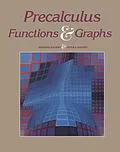
Precalculus: Functions & Graphs provides a complete and self-contained presentation of the basic mathematical techniques and ideas required for the successful completion of a calculus course. The book emphasizes the learning and understanding of the concept of a function, using function notation, and being able to sketch graphs of functions with ease. The text employs a number of pedagogic devices that have been proven effective in teaching college mathematics. The mathematical concepts are presented in a style that is informal, supportive, and "user-friendly". Progress checks, warnings, and features are inserted. Every chapter contains a summary, including terms and symbols with appr This textbook is intended for college students.
Inhalt
Preface
Acknowledgments
To the Student
Chapter 1 The Foundations of Algebra
1.1 The Real Number System
1.2 Polynomials and Factoring
1.3 Exponents, Radicals, and Complex Numbers
1.4 Linear Equations and Linear Inequalities in One Unknown
1.5 Absolute Value in Equations and Inequalities
1.6 Second-Degree Inequalities
Chapter 2 Functions and Graphs
2.1 The Rectangular Coordinate System
2.2 Functions and Function Notation
2.3 Graphs of Functions
2.4 Aids in Graphing
2.5 Linear Functions
2.6 Quadratic Equations
2.7 Quadratic Functions
2.8 Combining Functions; Inverse Functions
Chapter 3 Roots of Polynomials
3.1 Synthetic Division; The Remainder and Factor Theorems
3.2 Graphs of Polynomial Functions
3.3 The Rational Root Theorem and the Depressed Equation
3.4 Rational Functions and Their Graphs
3.5 Partial Fractions
Chapter 4 Exponential and Logarithmic Functions
4.1 Exponential Functions
4.2 Logarithmic Functions
4.3 Fundamental Properties of Logarithms
4.4 Computing with Logarithms (Optional)
4.5 Exponential and Logarithmic Equations
Chapter 5 Trigonometry: The Circular Functions
5.0 Review of Geometry
5.1 The Wrapping Function
5.2 The Sine, Cosine, and Tangent Functions
5.3 Graphs of Sine, Cosine, and Tangent
5.4 Values of Sine, Cosine, and Tangent
5.5 Graphs: Amplitude, Period, and Phase Shift
5.6 Secant, Cosecant, and Cotangent
5.7 The Inverse Trigonometric Functions
Chapter 6 Angles and Triangles
6.1 Angles and Their Measurement
6.2 Trigonometric Functions of Angles
6.3 Right Triangle Trigonometry
6.4 Law of Cosines
6.5 Law of Sines
Chapter 7 Analytic Trigonometry
7.1 Trigonometric Identities
7.2 The Addition Formulas
7.3 Double- and Half-Angle Formulas
7.4 The Product-Sum Formulas
7.5 Trigonometric Equations
Chapter 8 Complex Numbers and the Fundamental Theorem of Algebra
8.1 Complex Numbers and Their Properties
8.2 Trigonometry and Complex Numbers
8.3 The Fundamental Theorem of Algebra
8.4 Descartes's Rule of Signs
Chapter 9 Analytic Geometry: The Conic Sections
9.1 Analytic Geometry
9.2 The Circle
9.3 The Parabola
9.4 The Ellipse
9.5 The Hyperbola
9.6 Translation of Axes
9.7 Rotation of Axes
9.8 Polar Coordinates
9.9 Parametric Equations
Chapter 10 Systems of Equations and Inequalities
10.1 Systems of Equations
10.2 Systems of Linear Inequalities
10.3 Linear Programming (Optional)
10.4 Systems of Linear Equations in Three Unknowns
10.5 Matrices and Linear Systems
10.6 Matrix Operations and Applications (Optional)
10.7 Inverses of Matrices (Optional)
10.8 Determinants and Cramer's Rule
Chapter 11 Sequences and Series
11.1 Sequences and Sigma Notation
11.2 Arithmetic Sequences
11.3 Geometric Sequences
11.4 Mathematical Induction
11.5 The Binomial Theorem
Appendix A. Applications
Appendix B. Limits: A Preview of Calculus
Tables Appendix
Answers to Odd-Numbered Exercises and to Review Exercises and Progress Tests
Solutions to Selected Review Exercises
Index