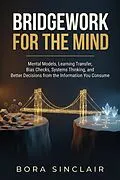
Bridgework for the Mind
Mental Models, Learning Transfer, Bias Checks, Systems Thinking, and Better Decisions from the Information You Consume
By Bora Sinclair
You can read constantly, save hundreds of notes, and still freeze when a real decision arrives. The missing step is often the work between information and action: connecting ideas, testing assumptions, spotting bias, and deciding which model actually fits the situation.
Bridgework for the Mind is a practical guide to that middle layer of thinking. It shows you how to turn scattered knowledge into a working system you can use when you learn, solve problems, evaluate claims, communicate ideas, or choose under uncertainty.
Instead of asking you to memorize a giant catalog of clever concepts, the book teaches a repeatable process. You learn how to build and revise mental models, connect ideas across domains, separate useful abstraction from oversimplification, and test what you believe against feedback from the real world.
Inside, you will learn how to:
- Build a usable set of mental models without turning them into trivia.
- Recognize confirmation bias, anchoring, availability effects, loss aversion, and other common distortions before they steer important decisions.
- Use active recall, spaced practice, explanation, and source diversity to make learning stick.
- Connect ideas from different fields without forcing weak analogies.
- Move between concrete examples and general principles while keeping track of where a model stops working.
- Run small experiments, record predictions, and use feedback to update your thinking.
- Improve your information diet by judging source quality, incentives, evidence, and signal-to-noise ratio.
- Break complex problems into parts, compare options through multiple lenses, and reason more clearly under uncertainty.
- Apply systems thinking to feedback loops, delays, leverage points, and unintended consequences.
- Communicate complicated ideas with clearer structure, better analogies, and more attention to the audience.
- Build decision journals, model cards, system maps, reflection cycles, and other tools you can reuse after the book is finished.
The chapters move from foundations to application. Early sections show how mental models and principles shape what you notice. The middle of the book focuses on connection, abstraction, experimentation, information quality, problem-solving, creativity, communication, decision-making, systems thinking, and critical evaluation. Later chapters examine ethics, continuous learning, knowledge management, the physical conditions that support thinking, and the traps that can turn confidence into dogmatism.
Each chapter closes with a practical exercise. You are asked to audit a decision, map a system, test a hypothesis, rotate a lens, review an information source, or document a pattern in your own reasoning. The purpose is simple: make better thinking observable enough to practice.
This book is especially useful for readers who consume a great deal of information but want a stronger method for deciding what matters. It is designed for managers, independent learners, creators, analysts, students, entrepreneurs, researchers, and anyone whose work depends on learning quickly and making judgments with incomplete information.
You do not need another stack of facts. You need a way to connect what you already know, notice where your reasoning is weak, and update your beliefs when reality pushes back.
Bridgework for the Mind gives you that working method.