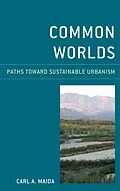
Common Worlds: Paths Toward Sustainable Urbanism explores expert and lay approaches to sustainable urbanism, focusing on the politics and civic aesthetics of space and place; project-based learning and it consequences for the life chances of youth; and the prospect of intergenerational civic engagement. Extended case studies of sustainable urbanism describe areas undergoing demographic and socioeconomic change over the two decades since the end of the Cold War. The case studies, based upon participatory action research, are framed through the lens of transformational anthropology, which focuses on the structural factors and power relationships that contribute to social and economic disparities within a population. This approach is based upon principles of personal and group transformation, and it holds researchers responsible for collaborating with communities and groups in co-constructing research, thereby enhancing the constituents' ability to carry out subsequent transformational change studies rooted in and shaped by the local community. Each case also focuses on a movement in support of aesthetic improvement, including preservation, conservation, and restoration efforts on behalf of parkland, open space, agricultural land, and marine wetlands in the face of external threats to their sustainability.
Autorentext
Carl A. Maida is a professor at the Institute of the Environment and Sustainability in the College of Letters and Science at the University of California, Los Angeles.
Zusammenfassung
Common Worlds: Paths Toward Sustainable Urbanism explores expert and lay approaches to sustainable urbanism, focusing on the politics and civic aesthetics of space and place; project-based learning and it consequences for the life chances of youth; and the prospect of intergenerational civic engagement. Extended case studies of sustainable urbanism describe areas undergoing demographic and socioeconomic change over the two decades since the end of the Cold War. The case studies, based upon participatory action research, are framed through the lens of transformational anthropology, which focuses on the structural factors and power relationships that contribute to social and economic disparities within a population. This approach is based upon principles of personal and group transformation, and it holds researchers responsible for collaborating with communities and groups in co-constructing research, thereby enhancing the constituents' ability to carry out subsequent transformational change studies rooted in and shaped by the local community. Each case also focuses on a movement in support of aesthetic improvement, including preservation, conservation, and restoration efforts on behalf of parkland, open space, agricultural land, and marine wetlands in the face of external threats to their sustainability.
Inhalt
Acknowledgments
Introduction
Chapter 1. Loss of the Agrarian Commons
Chapter 2. Toward the Urban Commons
Chapter 3. Recovering the Commons
Chapter 4. Engaging the Commons
Chapter 5. Monitoring the Commons
Chapter 6. Knowing the Commons
Chapter 7. The Commons in a Metropolitan World
Index
About the Author