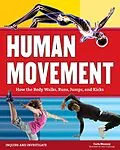
Why do we walk on two legs? How do our muscles know how to work together when we dance? How does our brain work with our hands to sink a basketball? In Human Movement: How the Body Walks, Runs, Jumps, and Kicks, readers ages 12 to 15 learn the basic anatomy and physiology of the human body and discover how bones, muscles, tendons, and nerves work together to make movement possible.
Bones give the body structure and the ability to stay upright. Muscles make possible the movement of the bones. The brain tells the muscles what to do and when to do it. And your heart, lungs, and other organs provide the fuel that powers movement. Human Movement takes a look at all of the components of the human body and examines how they allow you to move and interact with the world around you. Readers also learn what they can do to keep their bodies healthy and fit and moving well.
Combining hands-on activities with biology, chemistry, biomechanics, and nutrition, Human Movement offers entertaining graphic novel illustrations and fascinating sidebars to illuminate the topic and engage readers further. Human Movement integrates a digital learning component by providing links to primary sources, videos, and other relevant websites to deepen readers' experiences and strengthen practical connections to the material.
Projects include building a hand model with working muscles and tendons, testing what makes bones strong, examining how changing your center of gravity affects balance and motion, identifying how different types of joints work, and using yeast to investigate how the body metabolizes food into energy. Additional materials include a glossary, and a list of current reference works, websites, and Internet resources.
Autorentext
Carla Mooney is the author of several Nomad Press books including Comparative Religion: Investigate the World Through Religious Tradition, The U.S. Constitution: How Democracy Works, and The Industrial Revolution: Investigate How Science and Technology Changed the World. Carla lives in Pittsburgh, PA.
Sam Carbaugh has illustrated several books for Nomad Press, including Forensics: Uncover the Science and Technology of Crime Scene Investigation and Shakespeare: Investigate the Bard's Influence on Today's World, and he wrote and illustrated Comics: Investigate the History and Technology of American Cartooning. Sam lives in Grand Rapids, MI.
Sam Carbaugh has illustrated several books for Nomad Press, including Forensics: Uncover the Science and Technology of Crime Scene Investigation and Shakespeare: Investigate the Bard's Influence on Today's World, and he wrote and illustrated Comics: Investigate the History and Technology of American Cartooning. Sam lives in Grand Rapids, MI.
Inhalt
Timeline Introduction: Forces and Motion in the Human Body Chapter 1: The Skeleton What Makes Bones Strong? Build a Model of the Arm Chapter 2: The Muscular System Build a Working Hand Model Working in Pairs Finding Levers in the Body Chapter 3: The Brain-Body Connection Test Your Reaction Speed Involuntary Reflex Chapter 4: Help from the Organs Hormones: The Body's Communicators The Endocrine System: Fight or Flight? Breathe In, Breathe Out Chapter 5: Fuel to Move Not Enough Fuel: Muscle Fatigue Extracting Energy From Sugar How Much Chemical Energy Is In Your Food? Chapter 6: Moving On The Effect of Exercise on the Brain The Effect of Exercise on Lung Capacity Glossary Resources Index
Titel
Human Movement
Untertitel
How the Body Walks, Runs, Jumps, and Kicks
Autor
Illustrator
EAN
9781619304833
Format
E-Book (epub)
Hersteller
Digitaler Kopierschutz
Adobe-DRM
Dateigrösse
15.07 MB
Unerwartete Verzögerung
Ups, ein Fehler ist aufgetreten. Bitte versuchen Sie es später noch einmal.