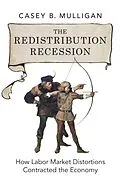
Redistribution, or subsidies and regulations intended to help the poor, unemployed, and financially distressed, have changed in many ways since the onset of the recent financial crisis. The unemployed, for instance, can collect benefits longer and can receive bonuses, health subsidies, and tax deductions, and millions more people have became eligible for food stamps. Economist Casey B. Mulligan argues that while many of these changes were intended to help people endure economic events and boost the economy, they had the unintended consequence of deepening-if not causing-the recession. By dulling incentives for people to maintain their own living standards, redistribution created employment losses according to age, skill, and family composition. Mulligan explains how elevated tax rates and binding minimum-wage laws reduced labor usage, consumption, and investment, and how they increased labor productivity. He points to entire industries that slashed payrolls while experiencing little or no decline in production or revenue, documenting the disconnect between employment and production that occurred during the recession. The book provides an authoritative, comprehensive economic analysis of the marginal tax rates implicit in public and private sector subsidy programs, and uses quantitative measures of incentives to work and their changes over time since 2007 to illustrate production and employment patterns. It reveals the startling amount of work incentives eroded by the labyrinth of new and existing social safety net program rules, and, using prior results from labor economics and public finance, estimates that the labor market contracted two to three times more than it would have if redistribution policies had remained constant. In The Redistribution Recession, Casey B. Mulligan offers hard evidence to contradict the notion that work incentives suddenly stop mattering during a recession or when interest rates approach zero, and offers groundbreaking interpretations and precise explanations of the interplay between unemployment and financial markets.
Autorentext
Professor of Economics, University of Chicago, author of Parental Priorities and Economic Inequality, weekly contributor to Economix blog for the New York Times
Inhalt
Preface Chapter 1 Introduction Chapter 2 The Rise of Labor Productivity Quarterly Indicators of Aggregate Economic Quantities Movements Along an Aggregate Marginal Productivity Schedule On Average, Real Wages did not Fall Was It Customer Demand? Factor Reduction and Factor Substitution by Industry Neither Wealth Effects nor Intertemporal Substitution Effects Explain the "Supply" Shift Labor Market Distortions since 2007 Conclusion: Productivity Patterns Begin to Reveal the Recession's Causes Appendix 2.1: Productivity, Labor, and Residuals in Prior Downturns Appendix 2.2: Sensitivity Analysis Chapter 3 The Expanding Social Safety Net A Framework for Quantifying the Generosity of the Safety Net as a Whole Legislation Made the Safety Net Available to Millions More Legislation Increased the Amount of Benefits Received per Program Participant Most of the Increase in Government Safety Net Expenditure is the Direct Result of Program Rule Changes Safety Net Rule Changes and Assistance for the Unemployed Means-tested Loan Forgiveness Conclusion: Replacement Rates for Aggregate Analysis Appendix 3.1: Calculation and Aggregation of Statutory Eligibility and Benefit Indices Appendix 3.2: Sensitivity Analysis Appendix 3.3: The Self-Reliance Rate Outlook Appendix 3.4: The Making Work Pay Tax Credit Chapter 4 Supply and Demand: Labor Market Consequences of Safety Net Expansions The Income-Maximization Fallacy Labor and Output Effects of Safety Net Expansions Predictions for Consumption and Investment Calibrating the Wage Elasticity of Aggregate Labor Supply Conclusions and Interpretation Appendix 4.1: Comparative Advantage with Heterogeneous Effects of the Safety Net Expansions Appendix 4.2: Calibrating the Supply Elasticity from Unemployment Duration Studies Appendix 4.3: Safety Net Distortions Measured in Dollars per Year Chapter 5 Means-Tested Subsidies and Economic Dynamics since 2007 The Neoclassical Growth Model with Targeted Means-Tested Subsidies Data and Simulation Results Effects of the Safety Net Expansion Interpreting the Residual Labor Market Distortions An Investment Distortion by Itself does not Fit Actual Behavior Conclusions Appendix 5.1: Calibration, Simulation, and Additional Sensitivity Analysis Chapter 6 Cross-Sectional Patterns of Employment and Hours Changes Cross-sectional Patterns of Self-Reliance Rate Changes Work Hours Changes by Demographic Group and Region Program Participation Changes by Demographic Group Conclusion: The Cross-Sectional Patterns of Employment and Hours Changes are as Expected from a Large Safety Net Expansion Appendix: Summary Statistics and Additional Results Chapter 7 Keynesian and Other Models of Safety Net Stimulus The Safety Net and Consumer Spending Transfers and Government Purchases are not the Same Labor Market Slack and the Marginal Effects of Supply Sticky Prices, the Wage Elasticity of Labor Demand, and the Zero Lower Bound An Econometric Model that Nests My Approach with the Slack Market and Sticky Price Hypotheses Conclusion: Whether Labor Supply Matters More, or Less, during a Recession is an Empirical Question Appendix: The Safety Net, Sticky Prices, and Monetary Policy Chapter 8 Recession-Era Effects of Factor Supply and Demand: Evidence from the Seasonal Cycle, the Construction Market, and Minimum Wage Hikes The Christmas and the Academic Seasons as Demand and Supply Shifts Christmas Demand in Recessions and Booms The Summer Seasonal for Employment and Unemployment Housing Investment Crowds Out Non-Residential Construction The Employment Effects of Recent Minimum Wage Hikes Were No Less than Before The Federal Minimum Wage Hikes Likely Reduced National Employment by Hundreds of Thousands, Especially Among the Young and Unskilled Conclusion: Labor Supply Still Matters, About as Much as It Did in the Past Chapter 9 Incentives and Compliance under the Federal Mortgage Modification Guidelines The Budget Set of a Borrower Facing the FDIC-HAMP Modification Guidelines Borrower Reactions under Full Information and Full Compliance: Spend More and Work Less Lender Incentives to Expand Modification Capacity Conclusions Appendix 9.1: Principal Modifications and the Eligible Income Range Appendix 9.2: Marginal Tax Rates with Various Horizons and Discount Rates Chapter 10 Uncertainty, Redistribution, and the Labor Market A Model of the Equity-Efficiency Tradeoff Possible Changes in the Equity-Efficiency Tradeoff, and the Optimal Degree of Social Insurance The Cost-Benefit Analysis of Safety Net Expansions: Necessary Ingredients Conclusions Chapter 11 Conclusions Incentives Matter Was the Financial Collapse a Cause, or Effect? Labor Supply and Demand Help Explain an Unhappy Situation Bibliography