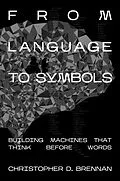
Large language models cannot reason in novel situations, cannot recognize what they do not know, and cannot learn after training ends. The diagnosis is settled. The cure is not.
The common fixes bolt machinery onto the model: knowledge graphs, retrieval, guardrails. But a curated graph cannot form a concept it was never given, and a frozen model cannot learn from yesterday.
This book introduces the Large Symbol Model, a cognitive architecture that reasons in symbols rather than predicting words, using language only to report the result. It organizes knowledge into role-structured contexts (WHO, WHAT, WHERE, WHEN, WHY, HOW), judges by coherence rather than probability, tracks how it knows what it knows, and keeps forming concepts and learning after deployment.
Its foundations are cognitive science: confabulation theory, fluid intelligence, working memory, and attention control. From Language to Symbols is a book for AI researchers and technology leaders, and equally for cognitive and social scientists, because a machine that reasons this way is also an account of why people do what they do.
Through high-stakes scenarios in warehouse automation, medical diagnosis, and intelligence analysis, it shows why trustworthy AI comes from architecture, not external rules, and invites you to help build what comes next.
Autorentext
Christopher D. Brennan is the founder and CEO of Matrix Intralogistics and co-founder and CTO of Merlin Terrestrial Positioning System. He began his AI career in the late 1990s at HNC Software, the company founded by Robert Hecht-Nielsen, whose confabulation theory underpins this work. Across twenty-five years in neural networks, symbolic reasoning, and autonomous systems, he has led engineering for billions of dollars in warehouse automation, orchestrating people, machines, and robots. He holds a BS in economic crime investigation from Utica College of Syracuse University, is the inventor on four patents pending, and received the 2025 TAG Impact Award from the Technology Association of Georgia.