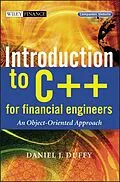
This book introduces the reader to the C++ programming language and how to use it to write applications in quantitative finance (QF) and related areas. No previous knowledge of C or C++ is required -- experience with VBA, Matlab or other programming language is sufficient. The book adopts an incremental approach; starting from basic principles then moving on to advanced complex techniques and then to real-life applications in financial engineering. There are five major parts in the book: * C++ fundamentals and object-oriented thinking in QF * Advanced object-oriented features such as inheritance and polymorphism * Template programming and the Standard Template Library (STL) * An introduction to GOF design patterns and their applications in QF Applications The kinds of applications include binomial and trinomial methods, Monte Carlo simulation, advanced trees, partial differential equations and finite difference methods. This book includes a companion website with all source code and many useful C++ classes that you can use in your own applications. Examples, test cases and applications are directly relevant to QF. This book is the perfect companion to Daniel J. Duffy's book Financial Instrument Pricing using C++ (Wiley 2004, 0470855096 / 9780470021620)
Autorentext
About the author
DANIEL J. DUFFY has been involved in software development projects using C++ and object-oriented design techniques since 1988. He organized the first C++ course in the Netherlands in 1989 and has worked on a variety of C++ projects in areas such as computer graphics, optical technology, process control and quantitative finance systems. In 1993 he worked on an early version of a large object-oriented system for derivatives pricing and hedging models. He is designer/trainer and has trained more than 2000 C++ developers in recent years.
A companion book to the current one is Financial Instrument Pricing using C++ (Wiley 2004). Since 1996 he has written seven books on object-oriented design and programming. Daniel Duffy has a PhD in Numerical Analysis from Trinity College Dublin. He lives in the Netherlands with his wife Ilona and son Brendan.
He can be contacted at dduffy@datasim.nl.
Klappentext
The object-oriented programming language C++ is the de facto standard for developing real-life applications for Quantitative Finance and Financial Engineering. This language was designed by Dr. Bjarne Stroustup in the early 1990's and it has become one of the most popular and robust languages for many important areas such as medical systems, computer graphics, telecommunications and in application areas where performance, accuracy and interoperability issues play a key role. The general expectation is that its importance will grow in the coming years.
C++ has also become the de facto standard for quant development and analysis. Knowledge of C++ is mandatory for many openings and job positions in Quantitative Finance. This book is the first book to discuss many of the issues that you need to know in order to be able to design and implement real-world applications. We focus on a number of critical topics:
- Learning the essential syntax of C++ ('getting the fundamentals right')
- Designing and implementing generic data structures using STL
- Numerous applications (lattices, finite difference, Monte Carlo, etc)
- Libraries, design patterns (GOF, POSA) and reusable software frameworks
- Introduction to COM and C++ to Excel interoperability
Each chapter deals with one major topic. Furthermore, each chapter builds only on the results of the chapters preceding it, so that we keep the amount of forward referencing to a minimum.We discuss all the syntax that is discussed in the IT books and we apply it to QF applications.
Last, but not least, each chapter concludes with exercises and projects to test what you learned in that chapter. The exercises are based on the tactic: 'get it working, then get it right, then get it optimised'. The exercises will also help you prepare for your job interviews.
Included with the book is a CD will full source code, including working code for lattice, finite difference and Monte Carlo methods for one-factor and two-factor pricing models as well as an easy-to-use C++ visualization package to help you examine the output from these numerical methods.
Inhalt
0 Goals of this Book and Global Overview 1
0.1 What is this book? 1
0.2 Why has this book been written? 1
0.3 For whom is this book intended? 2
0.4 Why should I read this book? 2
0.5 The structure of this book 2
0.6 What this book does not cover 2
0.7 More information and support 3
Part I C++ Essential Skills 5
1 Introduction to C++ and Quantitative Finance 7
1.1 Introduction and objectives 7
1.2 A short history of C++ 7
1.3 C++, a multi-paradigm language 8
1.4 C++ and quantitative finance: what's the relationship? 11
1.5 What is software quality? 11
1.6 Summary and conclusions 13
1.7 Exercises 14
2 The Mechanics of C++: from Source Code to a Running Program 15
2.1 Introduction and objectives 15
2.2 The compilation process 15
2.3 Header files and source files 16
2.4 Creating classes and using their objects 19
2.5 Template classes and template functions 22
2.6 Kinds of errors 25
2.7 The struct concept 27
2.8 Useful data conversion routines 27
2.9 Summary and conclusions 29
2.10 Exercises and projects 29
3 C++ Fundamentals and My First Option Class 31
3.1 Introduction and objectives 31
3.2 Class == member data + member functions 32
3.3 The header file (function prototypes) 33
3.4 The class body (code file) 35
3.5 Using the class 38
3.6 Examining the class in detail 40
3.7 Other paradigms 41
3.8 Summary and conclusions 45
3.9 Questions, exercises and projects 45
4 Creating Robust Classes 49
4.1 Introduction and objectives 49
4.2 Call by reference and call by value 49
4.3 Constant objects everywhere 52
4.4 Constructors in detail 54
4.5 Static member data and static member functions 55
4.6 Function overloading 57
4.7 Non-member functions 58
4.8 Performance tips and guidelines 58
4.9 Summary and conclusions 60
4.10 Questions, exercises and projects 60
5 Operator Overloading in C++ 63
5.1 Introduction and objectives 63
5.2 What is operator overloading and what are the possibilities? 63
5.3 Why use operator overloading? The advantages 65
5.4 Operator overloading: the steps 68
5.5 Using operator overloading for simple I/O 71
5.6 Friend functions in general 72
5.7 Summary and conclusions 74
5.8 Exercise 74
Appendix: useful data structures in C++ 75
6 Memory Management in C++ 79
6.1 Introduction and objectives 79
6.2 Single objects and arrays of objects on the stack 79
6.3 Special operators: 'new' and 'delete' 82
6.4 Small application: working with complex numbers 84
6.5 Creating an array class 86
6.6 Summary and conclusions 89
6.7 Exercises 89
6.8 Review questions and comments 91
7 Functions, Namespaces and Introduction to Inheritance 93
7.1 Introduction and objectives 93
7.2 Functions and function pointers 93
7.3 An introduction to namespaces in C++ 96
7.4 An introduction to the inheritance mechanism in C++ 99
7.5 Multiple inheritance 104
7.6 Solution of nonlinear equations 104
7.7 Nonlinear solvers in C++: design and implementation 106
7.8 Applying nonlinear solvers: …