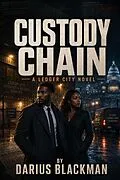
He thought the job was freedom. Then he found his name on a custody log.
In Custody Chain, Darius Blackman returns to Ledger City with a social suspense novel about reentry, labor exploitation, public contracts, warehouse logistics, forced labor, and the systems that rename captivity as opportunity.
Leon Vale needs the warehouse job to be a step forward.
Recently released from county custody, carrying debt, family responsibility, and the hope of rebuilding his life, Leon accepts work at Meridian Civic Logistics under the language of community supervision, structured rehabilitation, transitional work, and public-service logistics. The job is supposed to help him move forward.
Then Junie Bell shows him the wrong form.
It is not a shipping manifest.
It is a chain-of-custody log.
And it does not list property.
It lists people.
As Leon begins to understand the system around him, the warehouse changes shape. Gray vans, side gates, hidden routes, intake codes, transfer holds, shift assignments, public contracts, emergency purchases, and vendor language all point toward a machine that has learned how to move workers through public systems like inventory.
The official words sound clean: labor source, associate, structured program, public benefit. But the truth underneath is brutal. Some systems do not release people. They simply change the name of the cage.
Custody Chain is a Ledger City novel about reentry exploitation, public procurement, forced labor, warehouse logistics, carceral systems, and the people brave enough to expose a machine that calls control opportunity.
The door could lock.
The promise only had to sound open long enough to get a man through it.
The uploaded manuscript identifies Custody Chain as A Ledger City Novel, and its opening follows Leon Vale at Meridian Civic Logistics, where release papers say community supervision, the van driver's clipboard says labor source, and a chain-of-custody log begins revealing that people are being tracked like property.
Autorentext
Darius Blackman is the pen name of Bryan Frazier, a soldier of 22 years, father of three daughters, and independent author whose work is built around discipline, pressure, legacy, survival, love, history, identity, and the standards people live by when life demands more from them.
Blackman's nonfiction foundation is The Darius Blackman Standards Series, a five-book leadership and self-development collection shaped heavily by the lessons he learned through more than two decades in the Army. Through books such as A Man With Direction, Hold Your Ground, Built for Pressure, The Disciplined Man, and The Provider's Discipline, he writes directly to men who are ready to stop drifting, build stronger habits, protect their peace, carry responsibility, control their emotions, manage pressure, and become dependable in the places where weakness costs the most.
But Blackman's writing does not stop at self-development. His fiction moves with the same concern for consequence, identity, and power. In the Empire of Kimmett series, including The Exodus of Kemet, Convergence War, Fractured Infinity, and Thorn of convergence, he builds an Afrofuturist universe where ancient legacy, hidden history, advanced civilizations, leadership, survival, and the future of Black identity collide across worlds.
His Khemara books, including The awakening of Khemara: The first signal and Khemara Unbound, continue his interest in awakening, transformation, mystery, and ordinary people being pulled into realities larger than they ever imagined. These stories reflect one of Blackman's strongest creative themes: the moment when a person realizes the life they thought they understood was only the beginning.