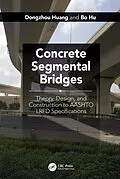
Segmental concrete bridges have become one of the main options for major transportation projects world-wide. They offer expedited construction with minimal traffic disruption, lower life cycle costs, appealing aesthetics and adaptability to a curved roadway alignment. The literature is focused on construction, so this fills the need for a design-oriented book for less experienced bridge engineers and for senior university students.
It presents comprehensive theory, design and key construction methods, with a simple design example based on the AASHTO LRFD Design Specifications for each of the main bridge types. It outlines design techniques and relationships between analytical methods, specifications, theory, design, construction and practice. It combines mathematics and engineering mechanics with the authors' design and teaching experience.
Autorentext
Dongzhou Huang, Ph.D., P.E., is Chief Engineer of Atkins North America and President of American Bridge Engineering Consultants, and has been a professor and visiting professor at Tongji University, Fuzhou University, and Florida International University for more than 20 years. He has been engaged in bridge engineering for over 40 years and has published numerous papers and books on bridge design, dynamic and stability analysis, practical analysis methods, and capacity evaluations of different types of bridges, including box girder, curved girder, cable-stayed, truss, and arch bridges. He has been extensively involved in the design, analysis, and construction of different types of long span and complex bridges, including span-by-span constructed, precast and cast-in-place cantilever segmental bridges, cable-stayed bridges, and arch bridges. He is an editor/board member of Journal of Structural Engineering International, IABSE and former associate editor of Journal of Bridge Engineering, ASCE.
Bo Hu, Ph.D., P.E., P.Eng., is an associate technical director in the Edmonton office of COWI. He obtained his Ph.D. in civil engineering from the University of Delaware in 2006. He has been engaged in bridge engineering for 20 years with research and design experiences in various bridge types, seismic behaviors of bridge structures, seismic design methodology for bridge structures, and development of innovative structures. He is a professional engineer in the United States and Canada and has been playing leading technical and project roles in a variety of large bridge projects in North America, including segmental concrete girder bridges, extradosed concrete segmental bridges, and cable-stayed concrete segmental bridges.
Inhalt
Unit Conversion Factors
Preface
Principal Notations
Chapter I. Introduction to Concrete Segmental Bridges
- AASHTO-PCI-ASBI Segmental Box Girder Standards
- Typical Post-Tensioning Systems by Freyssinet and TENSA
Chapter II. Loads on Bridges and General Design Methods
Chapter III. Fundamentals of Segmental Bridge Analysis and Design
Chapter IV General Analytical Theory of Superstructures
Chapter V. Design of Span-By-Span Construction and Common Details of Segmental Bridges
Chapter VI. Design of Cantilever Segmental Bridges
Chapter VII. Design of Incrementally Launched Segmental Bridges
Chapter VIII. Design of Post-Tensioned Spliced Girder Bridges
Chapter IX. Design of Segmental Arch Bridges
Chapter X. Design of Concrete Segmental Cable-Stayed Bridges
Chapter XI. Design of Substructures
Chapter XII. Segmental Bridge Construction
Appendices