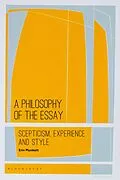
Erin Plunkett draws from both analytic and continental sources to argue for the philosophical relevance of style, making the case that the essay form is uniquely suited to address the sceptical problem. The authors examined here-Montaigne, Hume, the early German Romantics, Kierkegaard and Stanley Cavell-bring into relief the relationship between scepticism and ordinary life and situate the will to know within a broader frame of meaningful human activity. The formal features of the essay call attention to time, subjectivity, and language as the existential conditions of knowledge.
In contrast to foundationalist approaches, which expect philosophy to reach empirical or rational certainty, Plunkett demonstrates through these writings the philosophical advantages of a fragmentary, non-dogmatic style of writing. A Philosophy of the Essay shows how this medium can help us come to terms with the contingency and uncertainty of life.
Autorentext
Erin Plunkett is Lecturer in Philosophy and Religious Studies at the University of Hertfordshire, UK. She is currently researching the ontology and ethics of possibility in Kierkegaard and Jan Patocka. Her research interests are phenomenology, post-Kantian philosophy, Kierkegaard and existentialism, and the work of Stanley Cavell.
Inhalt
Introduction: Knowing and essaying
Chapter 1. Reciter L'homme in Montaigne's Essays
Chapter 2. Concepts in Conversation in the Humean Essay
Chapter 3. Infinite Approximation in the German Romantic Fragment
Chapter 4. Possibility in Kierkegaard's Imaginative Discourses
Chapter 5. Scepticism and Acknowledgement in Cavell's Essays
Conclusion
Bibliography
Index