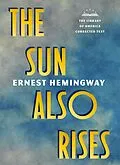
Library of America presents Hemingway's classic novel in a newly edited, authoritative text
With the publication of The Sun Also Rises, based on his experiences in Paris and Spain, Ernest Hemingway solidified his reputation as a leader of literary modernism and established himself as the preeminent voice of the Lost Generation. This Library of America edition presents a newly edited text of The Sun Also Rises, emended in consultation with Hemingway's manuscript and the typescript setting copy. It corrects numerous errors, restores key changes made to Hemingway's original punctuation, most notably in the novels famous final line, and reinstates references to real people removed by his editor Maxwell Perkins for reasons of impropriety or fear of libel.
The Sun Also Rises follows two of Hemingway's most memorable characters-Jake Barnes, an American newspaper correspondent living in Paris, and the impossible object of his affections, Lady Brett Ashley-and a cohort of other young American and British expatriates, amidst their dizzying, alcohol-fueled exploits in Paris, Pamplona, and Madrid (punctuated by a brief idyll in the Spanish countryside). Writing to F. Scott Fitzgerald in May 1926, Hemingway described his novel as "such a hell of a sad story…and the only instruction is how people go to hell."
Autorentext
Born in the Chicago suburb of Oak Park, Illinois, in 1899, Ernest Hemingway left home at seventeen to become a reporter for the Kansas City Star, then served as a Red Cross volunteer on the Italian front, where he suffered shrapnel wounds. He moved to Paris in 1921 and became part of an international expatriate scene that included Gertrude Stein and F. Scott Fitzgerald. Among his numerous books are In Our Time (1925), The Sun Also Rises (1926), A Farewell to Arms (1929), and For Whom the Bell Tolls (1940). Hemingway took his life in Ketchum, Idaho in 1961.
Robert W. Trogdon is Chair of the English Department at Kent State University and a leading scholar of 20th Century American Literature and textual editing. He has published extensively on the works of Ernest Hemingway. He serves as an editor of The Cambridge Edition of the Letters of Ernest Hemingway.