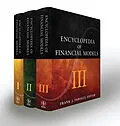
An essential reference dedicated to a wide array of financial models, issues in financial modeling, and mathematical and statistical tools for financial modeling
The need for serious coverage of financial modeling has never been greater, especially with the size, diversity, and efficiency of modern capital markets. With this in mind, the Encyclopedia of Financial Models, 3 Volume Set has been created to help a broad spectrum of individuals--ranging from finance professionals to academics and students--understand financial modeling and make use of the various models currently available.
Incorporating timely research and in-depth analysis, the Encyclopedia of Financial Models is an informative 3-Volume Set that covers both established and cutting-edge models and discusses their real-world applications. Edited by Frank Fabozzi, this set includes contributions from global financial experts as well as academics with extensive consulting experience in this field. Organized alphabetically by category, this reliable resource consists of three separate volumes and 127 entries--touching on everything from asset pricing and bond valuation models to trading cost models and volatility--and provides readers with a balanced understanding of today's dynamic world of financial modeling.
* Frank Fabozzi follows up his successful Handbook of Finance with another major reference work, The Encyclopedia of Financial Models
* Covers the two major topical areas: asset valuation for cash and derivative instruments, and portfolio modeling
* Fabozzi explores the critical background tools from mathematics, probability theory, statistics, and operations research needed to understand these complex models
* Organized alphabetically by category, this book gives readers easy and quick access to specific topics sorted by an applicable category among them Asset Allocation, Credit Risk Modeling, Statistical Tools
3 Volumes
onlinelibrary.wiley.com
Financial models have become increasingly commonplace, as well as complex. They are essential in a wide range of financial endeavors, and this 3-Volume Set will help put them in perspective.
Autorentext
Frank J. Fabozzi, PhD, CFA, CPA (New Hope, PA) is Professor of Finance at the Yale School of Management. Prior to joining the Yale faculty, he was a Visiting Professor of Finance in the Sloan School at MIT. Fabozzi is a Fellow of the International Center for Finance at Yale University and the Editor of the Journal of Portfolio Management and Associate Editor of the Journal of Fixed Income. He is an Affiliated Professor at the University of Karlsruhe's Institute of Statistics, Econometrics and Mathematical Finance and on the Advisory Council for the Department of Operations Research and Financial Engineering at Princeton University.
Inhalt
VOLUME 1
Asset Allocation
Mean-Variance Model for Portfolio Construction
Principles for Optimization for Portfolio SelectionAsset Allocation and Portfolio
Construction Modeling in Designing the Optimal Performance-Seeking Portfolio
Asset Pricing Models
General Principles of Asset Pricing
Capital Asset Pricing Models
Modeling Asset Price Dynamics
Arbitrage Pricing: Finite State Models
Arbitrage Pricing: Continuous State, Continuous Time Models
Bayesian Analysis and Financial Modeling Applications
Basic Principles of Bayesian Analysis
Bayesian Inference
Bayesian Estimation of ARCH-Type Volatillity Models
Bayesian Linear Regression Model
Bayesian Techniques and the Black-Litterman Model
Bond Valuation
Bond Valuation Modeling
Relative Value Analysis of Fixed Income Products
Yield Curves and Valuation Lattices
Using the Lattice Model to Value Bonds with Embedded Options, Floaters, and Caps/Floors
Understanding the Building Blocks of OAS Valuation
Quantitative Models to Value Convertible Bonds
Quantitative Approaches to Inflation-Indexed Bonds
Credit Risk Modeling
An Introduction to Credit Risk Models
Default Correlations in Intensity Model for Credit Risk Modeling
Structural Models in Credit Risk Modeling
Modeling Portfolio Credit Risk
Simulating the Credit Loss Distribution
Managing Credit Spreak Risk Using Duration Times Spread (DTS)
Credit Spread Decomposition
Credit Derviatives and Hedging Credit Risk
Derivatives Valuation
No-Arbitrage Price Relations for Forwards, Futures and Swaps
No-Arbitrage Price Relations for Options
Introduction to Contingent Claim Analysis
Black-Scholes Option Pricing Model
Basics of the Pricing of Futures/Forwards and Options
Pricing Options on Interest Rate Instruments
Basics of Currency Option Pricing Models
Credit Default Swaps Valuation
Valuation of Fixed Income Total Return Swaps
Pricing of Variance, Volatility, Covariance, and Correlation Swaps
Modeling, Valuation, and Risk Management of Assets and Derivatives in Energy and Shipping
VOLUME 2
Equity Models and Valuation
Dividend Discount Models
Discounted Cash Flow Method
Relative Valuation Methods for Equity Analysis
Equity Analysis in a Complex World
Equity Portfolio Selection Models in Practice
Quantitative Equity Investing Fundamentals
Quantitative Equity Portfolio Management
Forecasting Stock Returns
Factor Models for Portfolio Construction
Factor Models
Principal Component Analysis and Factor Analysis
Multifactor Equity Risk Models and Their Applications
Factor-Based Equity Portfolio Construction and Analysis
Cross-Sectional Factor-Based Models and Trading Strategies
The Fundamentals of Fundamental Factor Modeling
Applications of Fundamental Multifactor Equity Risk Models
Multifactor Fixed Income Risk Models and Their Applications
Financial Econometrics
Scope and Methods of Financial Econometrics
Regression Analysis: Theory and Estimation
Categorical and Dummy Variables in Regression Models
Quantile Regression
ARCH/GARCH Models in Applied Financial Econometrics
Classification and Regression Trees and Their Use in Financial Modeling
Cointegration and Its Application in Finance
Nonlinearity and Nonlinear Econometric Models in Finance
Robust Estimates of Betas and Correlations
Working with High-Frequency Data
Financial Modeling Principles
Milestone...