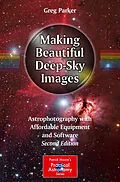
Autorentext
Professor Greg Parker was Head of the Nanoscale Systems Integration Group at Southampton University in southern England until his recent retirement. His deep-sky astronomical images have been published in Astronomy Now and Sky at Night magazines. He is the author of Introductory Semiconductor Device Physics (IOP, ISBN 0750310219), and has written many scientific papers and articles, mostly in the area of photonics and optoelectronics, as well as a chapter (Guided-wave Optical Communications: Materials) in Elsevier's Encyclopaedia of Materials: Science & Technology.
Klappentext
In this updated version of his classic on deep-sky imaging, astrophotographer Greg Parker describes how the latest technology can help amateur astronomers process their own beautiful images. Whether you are taking your own images from a backyard system or processing data from space telescopes, this book shows you how to enhance the visuals in the "electronic darkroom" for maximum beauty and impact. The wealth of options in the astrophotography realm has exploded in the recent past, and Parker proves an able guide for the interested imager to improve his or her comfort level against this exciting new technological backdrop.
From addressing the latest DSLR equipment to updating the usage of Hyperstar imaging telescopes and explaining the utility of parallel imaging arrays, this edition brings the book fully up-to-date, and includes clear tutorials, helpful references, and gorgeous color astrophotography by one of the experts inthe field.
Zusammenfassung
I have recently discovered the most satisfying hobby so far, and to be frank, I have pursued quite a few hobbies in my time! This one encompasses computers, optics, precision mechanics, digital image processing and artistic appreciation, and it therefore satisfies just about every major interest I have in one go. The hobby is taking photographic images of the deep-sky. I have not met anyone, so far, that has not been moved, sometimes to a great extent, by the images you will find within the pages of this book. Some people will actually admit to being frightened by the vastness of space that these images depict. I am not frightened by these images, but I am certainly awe-struck by them, and they do make me feel rather insignificant regarding the grand scale of things. I am also still firmly in the grip of being totally amazed that the capability to take such awe-inspiring images is now available to anyone with sufficient time and effort to dedicate to this most rewarding of hobbies. This book has two aims. The first is to show you the richness, wonder, and beauty of deep-sky objects. The second is to show you how you can take these images for yourself, using readily available commercial equipment.
Inhalt
How did I start?.- The Beginning and a Serious Health Warning!.- Assembling your Imaging System.- Computational Considerations Data Acquisition and Image Processing.- A Permanent Setup.- First Light Choosing your Objects.- First Light your First Objects.- Wide-Field Imaging with a Short Focal Length Refractor.- Hyperstar III Imaging.- Parallel Imaging with an Array.- Fundamentals of Image Processing.- Processing Professional Data.- The Deep-Sky Images.- Differentiating your Work.- Your Largest Resource.- Book Recommendations.- Appendix 1.- Appendix 2.- Physics World Article.- Greg Parker.- Postscript to the 2nd Edition.- Index.