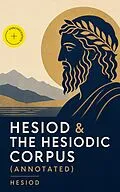
Hesiod & The Hesiodic Corpus gathers the works traditionally associated with archaic Greece's great didactic poet: above all the Theogony, Works and Days, and the fragmentary or disputed poems transmitted under his name. These texts move between cosmogony, divine genealogy, agrarian instruction, moral admonition, and mythic cataloguing, using the grave authority of dactylic hexameter in a mode distinct from Homeric heroic epic. Together they illuminate the emergence of Greek religious thought, social ethics, and poetic self-consciousness. Hesiod, usually placed in Boeotia around the late eighth or early seventh century BCE, presents himself not as a court singer of martial glory but as a farmer-poet addressed by the Muses. His world of labor, inheritance disputes, seasonal rhythms, and divine justice likely shaped the practical and moral urgency of his poetry. The later Hesiodic tradition expanded his authority, attaching to his name poems that systematized myth and genealogy for a pan-Hellenic audience. This volume is essential for readers seeking the foundations of Greek literature beyond Homer. It will reward classicists, historians of religion, students of mythology, and anyone interested in how poetry became a vehicle for ordering the cosmos, society, and human responsibility. This enriched edition has been carefully crafted to add value to your reading experience. - A succinct Introduction situates the work's timeless appeal and themes. - The Synopsis outlines the central plot, highlighting key developments without spoiling critical twists. - A detailed Historical Context immerses you in the era's events and influences that shaped the writing. - An Author Biography reveals milestones in the author's life, illuminating the personal insights behind the text. - A thorough Analysis dissects symbols, motifs, and character arcs to unearth underlying meanings. - Reflection questions prompt you to engage personally with the work's messages, connecting them to modern life. - Hand-picked Memorable Quotes shine a spotlight on moments of literary brilliance.
Autorentext
Hesiod was an ancient Greek poet generally thought to have been active between 750 and 650 BC, around the same time as Homer. He is generally regarded as the first written poet in the Western tradition to regard himself as an individual persona with an active role to play in his subject. Ancient authors credited Hesiod and Homer with establishing Greek religious customs. Modern scholars refer to him as a major source on Greek mythology, farming techniques, early economic thought, archaic Greek astronomy and ancient time-keeping.
Zusammenfassung
Hesiod is generally regarded as the first written poet in the Western tradition to regard himself as an individual persona with an active role to play in his subject. To these days three works have survived which were attributed to Hesiod by ancient commentators: Works and Days, Theogony, and Shield of Heracles. Only fragments exist of other works attributed to him. The Theogony is commonly considered Hesiod's earliest work. It concerns the origins of the world (cosmogony) and of the gods (theogony), beginning with Chaos, Gaia, Tartarus and Eros, and shows a special interest in genealogy. The Works and Days is a poem of over 800 lines which revolves around two general truths: labour is the universal lot of Man, but he who is willing to work will get by. This work lays out the five Ages of Man, as well as containing advice and wisdom, prescribing a life of honest labour and attacking idleness and unjust judges as well as the practice of usury. The subject of The Shield of Heracles is the expedition of Heracles and Iolaus against Cycnus, the son of Ares, who challenged Heracles to combat as Heracles was passing through Thessaly. Contents: Hesiod's Works and Days The Divination by Birds The Astronomy The Precepts of Chiron The Great Works The Idaean Dactyls The Theogony The Catalogues of Women and Eoiae The Shield of Heracles The Marriage of Ceyx The Great Eoiae The Melampodia The Aegimius Fragments of Unknown Position Doubtful Fragments