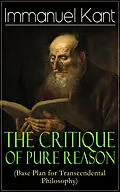
The Critique of Pure Reason (Base Plan for Transcendental Philosophy) is Kant's monumental inquiry into the conditions that make knowledge possible. Written in a rigorous, architectonic style, it examines sensibility, understanding, reason, and the limits of metaphysics through concepts such as synthetic a priori judgment, the categories, and transcendental idealism. Situated at the crossroads of Enlightenment rationalism and empiricism, it redefines philosophy's task as a critique of reason's powers and boundaries. Immanuel Kant, the Prussian philosopher of Königsberg, composed this work after decades of engagement with Leibnizian rationalism, Newtonian science, and the skeptical challenge of David Hume, whom he famously credited with awakening him from "dogmatic slumber." His disciplined life and academic career shaped a project seeking to secure science, morality, and metaphysics against both uncritical speculation and corrosive doubt. This book is essential for readers prepared to think slowly and carefully about knowledge, reality, and the human mind. Demanding yet transformative, it rewards philosophers, theologians, historians of ideas, and serious general readers with a new understanding of modern thought's foundations. This enriched edition has been carefully crafted to add value to your reading experience. - A succinct Introduction situates the work's timeless appeal and themes. - The Synopsis outlines the central plot, highlighting key developments without spoiling critical twists. - A detailed Historical Context immerses you in the era's events and influences that shaped the writing. - An Author Biography reveals milestones in the author's life, illuminating the personal insights behind the text. - A thorough Analysis dissects symbols, motifs, and character arcs to unearth underlying meanings. - Reflection questions prompt you to engage personally with the work's messages, connecting them to modern life. - Hand-picked Memorable Quotes shine a spotlight on moments of literary brilliance. - Interactive footnotes clarify unusual references, historical allusions, and archaic phrases for an effortless, more informed read.
Autorentext
Giselle Potter has illustrated many books, including Kate and the Beanstalk by Mary Pope Osborne, an ALA-ALSC notable book; The Boy Who Loved Words by Roni Schotter, a Parents’ Choice Gold Award winner; and Cecil the Pet Glacier by Matthea Harvey. She is the author and illustrator of Tell Me What to Dream About and This Is My Dollhouse—both inspired by her daughters—and The Year I Didn't Go to School, about traveling through Italy with her parents’ puppet troupe when she was eight. Giselle also illustrates a weekly column called “Ties” for The New York Times. She lives in Rosendale, New York, with her husband and two daughters. Visit her online at GisellePotter.com.
Klappentext
This carefully crafted ebook: "The Critique of Pure Reason (Base Plan for Transcendental Philosophy)" is formatted for your eReader with a functional and detailed table of contents.
The Critique of Pure Reason is one of the most influential works in the history of philosophy and marks a turning point and the beginning of modern philosophy. Also referred to as Kant's "first critique," it was followed by the Critique of Practical Reason and by the Critique of Judgment. In the preface to the first edition, Kant explains what he means by a critique of pure reason: "I do not mean by this a critique of books and systems, but of the faculty of reason in general, in respect of all knowledge after which it may strive independently of all experience."
Immanuel Kant (1724-1804) was a German philosopher, who, according to the Stanford Encyclopedia of Philosophy is "the central figure of modern philosophy." Kant argued that fundamental concepts of the human mind structure human experience, that reason is the source of morality, that aesthetics arises from a faculty of disinterested judgment, that space and time are forms of our understanding, and that the world as it is "in-itself" is unknowable. Kant took himself to have effected a Copernican revolution in philosophy, akin to Copernicus' reversal of the age-old belief that the sun revolved around the earth.
Zusammenfassung
A long time ago, in Greece, there lived a beautiful princess named Areti. She had many suitors, but none she liked -- so she decided to make one from semolina, almonds, and sugar. Out of the bowl climbed the most handsome man Areti had ever seen: Mr. Semolina-Semolinus, a man more beautiful than love itself, and twice as rare. So when an evil queen far away steals Areti's beloved, what does she do? She orders three pairs of iron shoes, and sets off on a daring rescue attempt, for nothing will stand between this princess and her dreams.
Leseprobe
Preface to the Second Edition, 1787
Table of Contents
Whether the treatment of that portion of our knowledge which lies within the province of pure reason advances with that undeviating certainty which characterizes the progress of science, we shall be at no loss to determine. If we find those who are engaged in metaphysical pursuits, unable to come to an understanding as to the method which they ought to follow; if we find them, after the most elaborate preparations, invariably brought to a stand before the goal is reached, and compelled to retrace their steps and strike into fresh paths, we may then feel quite sure that they are far from having attained to the certainty of scientific progress and may rather be said to be merely groping about in the dark. In these circumstances we shall render an important service to reason if we succeed in simply indicating the path along which it must travel, in order to arrive at any results - even if it should be found necessary to abandon many of those aims which, without reflection, have been proposed for its attainment.
That logic has advanced in this sure course, even from the earliest times, is apparent from the fact that, since Aristotle, it has been unable to advance a step and, thus, to all appearance has reached its completion. For, if some of the moderns have thought to enlarge its domain by introducing psychological discussions on the mental faculties, such as imagination and wit, metaphysical discussions on the origin of knowledge and the different kinds of certitude, according to the difference of the objects (idealism, scepticism, and so on), or anthropological discussions on prejudices, t…