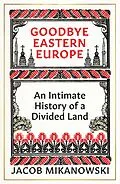
An epic history of the 'other' Europe, a place of conflict and coexistence, of faith and folklore.
'Do not rush to bid farewell to eastern Europe until reading this book. Meticulously researched and beautifully written.' Serhii Plokhy
Eastern Europe is more than the sum total of its annexations, invasions and independence declarations. From the Baltics to the Balkans, from Prague to Kiev, the area exuded a tragicomic character like no other.
This is a paean for a disappearing world of movable borders, sacred groves and syncretism. And an invitation to not forget.
***
A SPECTATOR BOOK OF THE YEAR 2023
'An insightful chronicle… distilling more than a decade of research, [Mikanowski] carefully argues that if something marks out Europe's eastern half, it is not homogeneity but wild, glorious diversity.' Economist
'A lively and sweeping history.' Washington Post
'Goodbye Eastern Europe is a thematic history of a divided half-continent, a goulash of imperial histories, shifting frontiers and heartbreaking family stories, spiced with myth and poet-martyrs, and deeply satisfying on the palate… vital and informed.' TLS
Autorentext
Jacob Mikanowski is a writer and academic. His parents were Polish immigrants to the US, and he spent his childhood between Poland and Pennsylvania. He is now a PhD candidate at the UC Berkeley in California. Concurrently, he has become a well-known essayist and freelance journalist, writing pieces for publications including the Guardian, New York Times, Atlantic, New Yorker, Harper's, Slate, Aeon, Prospect Magazine and many more. His two long reads for the Guardian were included in the paper's 'Best of the Year' round-up in 2018.
Klappentext
Eastern Europe is disappearing. Not off the map of course, but as an idea.
Today it calls to mind a jumble of post-Soviet states paved over with C&A and McDonald's. We could describe Eastern Europe as a group of twenty nations - but why? For most of their history, they weren't nations at all.
The region is more than the sum total of its annexations, invasions and independence declarations. Eastern Europe abounds with peoples tied together by tragicomic twists of fate. Lives could be turned upside down by distant decrees from Vienna or Istanbul, or just as easily by a stubborn bureaucrat in your village. In twentieth-century Knust, you could live in six different countries without ever leaving your house. You could get married any day, but buying a teakettle was a singular event.
Goodbye Eastern Europe is a eulogy for a world we are losing as memories fade and new malls get built. We may not be able to conquer fate - but we can delight in its mystery.