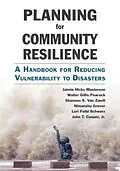
How can we plan and design stronger communities? From New Orleans to Galveston to the Jersey Shore, communities struck by natural disasters struggle to recover long after the first responders have left. Globally, the average annual number of natural disasters has more than doubled since 1980. These catastrophes are increasing in number as well as in magnitude, causing greater damage as we experience rising sea levels and other effects of climate change. Communities can reduce their vulnerability to disaster by becoming more resilient-to not only bounce back more readily from disasters but to grow stronger, more socially cohesive, and more environmentally responsible. To be truly resilient, disaster preparation and response must consider all populations in the community. By bringing together natural hazards planning and community planning to consider vulnerabilities, more resilient and equitable communities are achievable. In Planning for Community Resilience the authors describe an inclusive process for creating disaster-resilient communities. Based on their recovery work after Hurricane Ike in Galveston, Texas, they developed a process that relies on the Disaster Impacts Model. This handbook guides any community through the process of determining their level of hazard exposure, physical vulnerability, and social vulnerability with the goal of determining the best planning strategy. Planning for Community Resilience will be invaluable to professionals working to protect their community from disturbance, including city planners, elected officials, floodplain managers, natural hazard managers, planning commissioners, local business leaders, and citizen organizers.
Autorentext
Jaimie Hicks Masterson is the Program Coordinator of Texas Target Communities at Texas A&M University. Walter Gillis Peacock, Ph.D., is a Professor in the Departmof Landscape Architecture and Urban Planning and Director of the Hazard Reduction & Recovery Center at Texas A&M University. Shannon S. Van Zandt, Ph.D. is Associate Professor in the Departmof Landscape Architecture and Urban Planning and the Director of the Center for Housing and Urban Developmat Texas A&M University. Himanshu Grover, Ph.D., is Assistant Professor in the Departmof Urban Planning and Regional Planning at the University of Buffalo. Lori Feild Schwarz is the Comprehensive Planning Manager for the City of Plano, Texas. John T. Cooper, Jr., Ph.D. is Associate Professor of Practice in the Departmof Landscape Architecture and Urban Planning at Texas A&M University.
Inhalt
1: The New Era of Catastrophes
2: What Is Resilience?
3: Organizing and Connecting through the Disaster Phases
4: Assessing Hazard Exposure
5: Assessing Physical Vulnerability
6: Assessing Social Vulnerability
7: An Assessment of Hazard Mitigation Plans
8: Planner's Toolbox
9: Striving for Consistency
10: Conclusion