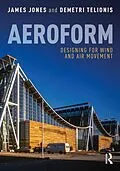
Aeroform: Designing for Wind and Air Movement provides a comprehensive introduction to applying aerodynamic principles to architectural design. It presents a challenge to architects and architectural engineers to give shape to the wind and express its influence on architectural form.
The wind pushes and pulls on our buildings, infiltrates and exfiltrates through cracks and openings, and lifts roofs during storm events. It can also offer opportunities for resource conservation through natural ventilation or a biophilic connection between indoors and out. This book provides basic concepts in fluid mechanics such as materials, forces, equilibrium, pressure, and hydrostatics; introduces the reader to the concept of airflow; and provides strategies for designing for wind resistance, especially in preventing uplift. Natural ventilation and forced airflow are explored using examples such as Thomas Herzog's Hall 26 in Hanover, RWE Ag building in Essen Germany, and the Kimbell Art Museum in Texas. Finally, issues of wind and airflow measurement are addressed.
A reference for students and practitioners of architecture and architectural engineering, this book is richly illustrated and presents complex concepts of aerodynamic engineering in easy-to-understand language. It prepares the architect or architectural engineer to design buildings that are visually expressive of a dialogue between wind and built form.
Autorentext
Demetri Telionis is the Francis J. Maher emeritus professor at VA Tech. He received his MS and PhD from Cornell University and then served on the faculty of Virginia Tech. Telionis directed and participated in research funded by NASA, NSF, ONR, AFOSR, DOE, NAVAIR, ARO and DOT. He has written one book, edited three more, and authored or co-authored over 160 papers. Dr. Telionis is a fellow of the American Society of Mechanical Engineers, has served for three years as an associate editor of the ASME Journal of Fluids Engineering, then for another 10 years as the editor in chief of this Journal. Telionis is one of the founders of Aeroprobe Corp, a company dedicated to the design and marketing of engineering instrumentation and has served three years as its CEO.
Jim Jones is a Professor of Architecture in the School of Architecture + Design (SA+D) at Virginia Tech. He received his BS, MArch and PhD from the College of Architecture and Urban Planning at the University of Michigan. He provides instruction related to environmental building systems, resource conservation, and health and wellness design to undergraduate and graduate students. Dr. Jones oversees the Design Research stream within the PhD Program for the SA+D. He also directs the Center for High Performance Environments that has been recognized as a Center of Excellence by the US Department of Energy and the Environmental Protection Agency. He has been a Continuing Education Provider for the American Institute of Architects and a member of the American Society of Heating, Refrigerating and Air Conditioning Engineers. He was the Principle Investigator for the design development and patent of the V2T roof vent system.
Klappentext
Aeroform: Designing for Wind and Air Movement provides a comprehensive introduction to applying aerodynamic principles to architectural design. It presents a challenge to architects and architectural engineers to give shape to the wind and express its influence on architectural form.
The wind pushes and pulls on our buildings, infiltrates and exfiltrates through cracks and openings, and lifts roofs during storm events. It can also offer opportunities for resource conservation through natural ventilation or a biophilic connection between indoors and out. This book provides basic concepts in fluid mechanics such as materials, forces, equilibrium, pressure and hydrostatics, introduces the reader to the concept of airflow, and provides strategies for designing for wind resistance, especially in preventing uplift. Natural ventilation and forced airflow are explored using examples such as Thomas Herzog's Hall 26 in Hanover, RWE Ag building in Essen Germany, and the Kimbell Art Museum in Texas. Finally, issues of wind and airflow measurement are addressed.
A reference for students and practitioners of architecture and architectural engineering, this book is richly illustrated, and presents complex concepts of aerodynamic engineering in easy-to understand language. It prepares the architect or architectural engineer to design buildings that are visually expressive of a dialogue between wind and built form.
Inhalt
1. Introduction
2. Basic Concepts in Fluid Mechanics
3. Wind and Airflow
4. Design for Wind Resistance
5. Roofs and Response to Uplift
6. Natural Ventilation
7. Forced Air Flow
8. Measurement and Instrumentation