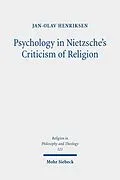
Friedrich Nietzsche claimed to be a psychologist. This claim is substantiated in his criticism of religion. In this book, Jan-Olav Henriksen provides new perspectives on Nietzsche's contribution to such criticism by applying elements from attachment theory and self-psychology. The result is that Nietzsche's insights into the problematic elements in religion point beyond what he was able to articulate based on the psychological resources available to him. Henriksen sheds new light on the psychological dimensions in Nietzsche's individualism, his understanding of God, morality, metaphysics and emotions, and demonstrates how Nietzsche's criticism of religion is rooted in both psychological splitting and a profound loss of the orientational resources religion provided in his childhood.
Born 1961; 1990 Dr. theol.; 2000 Alan Richardson Fellow at the University of Durham, UK; 2002 Dr. philos.; since 1994 professor of systematic theology at MF Norwegian School of Theology; currently also Dean of Research; member of the Center of Theological Inquiry, Princeton, NJ.
Born 1961; 1990 Dr. theol.; 2000 Alan Richardson Fellow at the University of Durham, UK; 2002 Dr. philos.; since 1994 professor of systematic theology at MF Norwegian School of Theology; currently also Dean of Research; member of the Center of Theological Inquiry, Princeton, NJ.
Titel
Psychology in Nietzsche's Criticism of Religion
Untertitel
On Splitting and Loss of Orientation
Autor
EAN
9783161618215
Format
E-Book (pdf)
Hersteller
Digitaler Kopierschutz
Adobe-DRM
Dateigrösse
1.32 MB
Anzahl Seiten
207
Unerwartete Verzögerung
Ups, ein Fehler ist aufgetreten. Bitte versuchen Sie es später noch einmal.