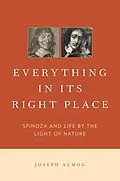
In Everything in Its Right Place, Joseph Almog develops the unitarian and universalist metaphysics of Spinoza. Spinoza's ground zero thesis is that "Nature is one and all." Everything (including God, mathematics, morals, our own thoughts) finds its place within Spinoza's (capital N) Nature. It is the place that each thing occupies within the grid of Nature-from God on down the cosmic tree of being-that determines its fundamental (lowercase n) nature. For Spinoza, one's nature is determined by one's place in Nature or, in terms of the fundamental axiom of the book-the Nature-unfolding axiom: the nature of x=Nature at x. Almog's reading of Spinoza is distinct in its understanding of the deductive abstractions of part I-II of the Ethics by means of the concrete illustrations of Spinoza's intended subject matter in his political writings, where he tells us directly (i) what Nature is and (ii) how man's nature is not a separate kingdom from the Nature-kingdom but merely an unfolding of it. This leads, as in the Ethics, to a final chapter on what it meant to Spinoza to live in symbiosis with Nature and, therefore, to be one with it-and with God.
Autorentext
Joseph Almog is the author of Referential Mechanics (forthcoming), Cogito: Descartes and Thinking the World (2008), What Am I? Descartes and the Mind-Body Problem (2001) and co-editor of Essays on Reference, Language, and Mind by Keith Donellan (2012), Having in Mind: The Philosophy of Keith Donnellan (2012), and The Philosophy of David Kaplan (2009) -- all from Oxford University Press.
Zusammenfassung
In Everything in Its Right Place, Joseph Almog develops the unitarian and universalist metaphysics of Spinoza. Spinoza's ground zero thesis is that "e;Nature is one and all."e; Everything (including God, mathematics, morals, our own thoughts) finds its place within Spinoza's (capital N) Nature. It is the place that each thing occupies within the grid of Nature-from God on down the cosmic tree of being-that determines its fundamental (lowercase n) nature. For Spinoza, one's nature is determined by one's place in Nature or, in terms of the fundamental axiom of the book-the Nature-unfolding axiom: the nature of x=Nature at x. Almog's reading of Spinoza is distinct in its understanding of the deductive abstractions of part I-II of the Ethics by means of the concrete illustrations of Spinoza's intended subject matter in his political writings, where he tells us directly (i) what Nature is and (ii) how man's nature is not a separate kingdom from the Nature-kingdom but merely an unfolding of it. This leads, as in the Ethics, to a final chapter on what it meant to Spinoza to live in symbiosis with Nature and, therefore, to be one with it-and with God.
Inhalt
Chapter 1 Introduction - why, what and how Spinoza? Chapter 2 Nature is one Chapter 3 Nature is all Chapter 4 Man as a force of Nature-desire, acting and the metaphysics of politics Chapter 5 Life by the light of Nature: Love of God and partaking in infinity Acknowledgments Index