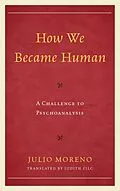
How We Became Human: A Challenge to Psychoanalysis tackles the question of what distinguishes human beings from other animals. By interweaving psychoanalysis, biology, physics, anthropology, and philosophy, Julio Moreno advances a novel thesis: human beings are faulty animals in their understanding of the world around them. This quality renders humans capable of connecting with inconsistencies, those events or phenomena that their logic cannot understand. The ability to go beyond consistency is humans' distinctive trait. It is the source of their creativity and of their ability to modify the environment they inhabit. On the basis of this connective-associative interplay, Moreno proposes a new approach to the links human beings create amongst themselves and with the world around them. This theory focuses on a key question: What is the difference between human beings and the other animals? From this perspective, Moreno seeks to reformulate many of the classic psychoanalytic, psychological, and anthropological postulates on childhood, links, and psychic change.
Autorentext
Julio Moreno, MD, PhD, is a faculty member at Buenos Aires Psychoanalytic Association's Psychoanalytic Institute, the School of Psychology at Buenos Aires University, and the University of Hospital Italiano. His previous works include Tiempo y trauma: Continuidades rotas, and La infancia y sus bordes: Desafíos para el psicoanálisis.
Zusammenfassung
How We Became Human: A Challenge to Psychoanalysis tackles the question of what distinguishes human beings from other animals. By interweaving psychoanalysis, biology, physics, anthropology, and philosophy, Julio Moreno advances a novel thesis: human beings are faulty animals in their understanding of the world around them. This quality renders humans capable of connecting with inconsistencies, those events or phenomena that their logic cannot understand. The ability to go beyond consistency is humans' distinctive trait. It is the source of their creativity and of their ability to modify the environment they inhabit. On the basis of this connective-associative interplay, Moreno proposes a new approach to the links human beings create amongst themselves and with the world around them. This theory focuses on a key question: What is the difference between human beings and the other animals? From this perspective, Moreno seeks to reformulate many of the classic psychoanalytic, psychological, and anthropological postulates on childhood, links, and psychic change.
Inhalt
Acknowledgments
Preface
Chapter 1: Humanness
Chapter 2: Virtual Reality
Chapter 3: Connection and Association
Chapter 4: The Link I: Theory
Chapter 5: The Link II: Manifestations
Chapter 6: Belief
Chapter 7. Childishness
Chapter 8: Childishness II: The History of Childhood and Toys
Chapter 9: The Emergence of Humanness
Chapter 10: The Biological History of the Parent-Child Link: Childrearing Strategies
References
Index
About the Author