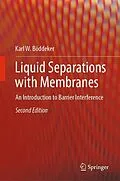
Exploiting barrier interference is the challenge of membrane separation science and technology. This book provides expert knowledge as a survey, in systematic order, of the terms and concepts by which barrier separations operate, and through which practical membrane separation processes are designed. The aim of this book is to present the relevant thermodynamic features of fluid mixtures in contact with semipermeable barriers, then to apply this information in deriving the working principles and design requirements of individual membrane separation processes. The membranes, by this approach, are introduced by way of the mass transport and selectivity demands which they are to meet.
Autorentext
Karl W. Böddeker became Professor at Technical University Hamburg (TUHH) while he already was well known as an expert on desalination and pervaporation in the scientific community, both in EMS and NAMS. He retired from GKSS Research in 2005 but is still active as lecturer at TUHH. He served as an editor for the Journal of Membrane Science and still is an active editor for Membrane News, the quarterly newsletter of the European Membrane Society (EMS).
Klappentext
This book presents a self-consistent approach to separations of liquids with membranes, contrasting equilibrium separations with the rate-controlling effects of barrier interference on mass transfer. Unlike equilibrium separations, which depend on the thermodynamic condition of the fluid mixtures alone, barrier separations additionally are subject to specific interactions of the mixture components with the barrier. While the thermodynamics of fluid mixtures is predictable and open to adjustment, barrier interference adds another dimension to the repertoire of separation effects. Exploiting barrier interference is the challenge of membrane separation science and technology. This book is about the principles behind.
This second edition incorporates the remarkable new developments especially in the field of hydrophobicity of surfaces and closely connected membrane distillation. Additionally, the new edition includes a chapter on Electrodialysis and its potential for energy efficient seawater desalination.
Zusammenfassung
On the level of a textbook a self-consistent approach to liquid separations with membranes is presented, contrasting equilibrium separations with the rate-controlling effects of barrier interference on mass transfer. As a corollary objective, an effort is made to observe context, factual and historical, when introducing concepts and applications of membrane separation science. Ordering principle is the formal structure of mass transfer across permeable barriers, being construed of a driving force (allocated to the condition of the mixtures to be separated) and a barrier permeability (holding the keys to membrane selectivity). The membranes, by this approach, appear by way of the mass transport requirements which they are to meet, or else by way of the separation effects which they inspire. Exploiting barrier interference is the challenge of membrane separation science and technology. This book is about the principles behind.
Inhalt
An Introduction to Barrier Separation.- The Thermodynamic Connection.- Osmosis et cetera.- Membrane Filtration.- Pervaporation versus Evaporation.- What Membranes are About.- Tracing Membrane Science, an Historical Account.