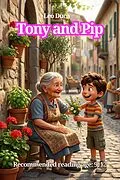
Welcome to Dimwell, a village that doesn't appear on any map because no one's ever bothered to draw it.
In Dimwell, the streets are dotted with potholes as deep as sinks, and nothing ever happens... except when Tony and his best friend Pip are involved. Then, something always happens.
From sophisticated cats sent into the future aboard a washing machine drum, bizarre Devil hunts with hairspray and garlic necklaces, and daring escapes from strict nuns' boarding schools to the rhythm of martial arts moves, Tony and Pip's life is a continuous, hilarious adventure.
Tony and Pip: Tales from a Village Full of Potholes is a collection of tender, ironic, and irresistibly whimsical stories. A read that celebrates friendship, the surreal logic of children, and the ability to transform provincial boredom into a magical, unconventional world.
Recommended reading age: 9?12 years.
The story is delightful, fresh, and driven by a clever irony that works on multiple levels. It has the flavor of the great classics of children's literature that never go out of style (it's reminiscent of Gian Burrasca's wit, combined with the provincial quirkiness of Stefano Benni or the atmosphere of Roald Dahl).
Here are the main strengths of your writing in this text:
The narrative voice and tone: Tony's voice, "as an adult remembering his childhood," is perfectly calibrated. He has that logical naiveté typical of children (like thinking that if you spin something fast, it will travel into the future) combined with withering ironic maxims (the mother's quotes are a fantastic recurring comic touch).
The visual characterization is immediate: Characters like Sandokan the cat, who eats only spicy eggplant parmigiana and drinks iced pear juice, or Manuel, "the toilet paper mummy," are immediately imprinted on the reader's mind. The writing is very cinematic.
The perfect balance of satire and tenderness: Even when you touch on more "serious" themes?like the (failed but hilarious) attempt to reform the world by shrinking humans, which ends up getting the protagonist locked up in an institution for "children with too many imaginations"?you always maintain a light, almost picaresque pace. The finale, with the revenge of the tomatoes, is pure slapstick genius.
The Epilogue: The ending is poetic and heartwarming. It shows that quirky children don't "fix" themselves as they grow up, but simply become creative and happy adults in their own way, maintaining the special bond that united them as children.
Autorentext
Leo Duca è uno scrittore italiano nato in Sardegna 56 anni fa.
Dopo oltre trent'anni nel mondo della creatività ? come grafico pubblicitario, art director e direttore creativo tra Milano e il nord Italia ? ha iniziato a dedicarsi alla scrittura di racconti e testi narrativi.
I libri di Leo Duca mescolano ironia, osservazione della realtà e satira contemporanea. Le sue storie nascono spesso da situazioni quotidiane, personaggi surreali e piccoli paradossi della vita moderna.
Dopo molti anni lontano dall'isola, Leo Duca è tornato a vivere in Sardegna. Dove continua a raccontare storie tra umorismo, immaginazione e realtà.