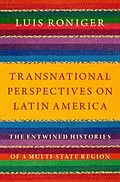
Latin America is a region made up of multiple states and societies with a diversity of races, ethnicities, and cultures. These states share historical legacies, cultural backgrounds and institutional frameworks, as well as political and socioeconomic challenges--but can one say they share a "regional perspective," if such perspectives even exist? In Transnational Perspectives on Latin America, Luis Roniger argues that the notion of Latin America is significant for understanding these societies' multiple connections and spillover across state boundaries. He claims that cross-border networks, a protracted concern and at times involvement in the affairs of neighboring states have shaped the region's modern character as much as the process of nation-state formation. Geopolitical, sociological, and cultural trends molded a contiguity of influences, leading sometimes to state confrontations, but overall, shaping a transnational arena of connected histories, interactions, and visions, complementing the process of separate nation-state formation. The book offers fresh readings of the dynamics of this region of multiple societies that have shared historical and cultural connections and developed divergent paths while unable to fully disengage from one another. Its chapters analyze persisting forms of circulation and articulation of networks, practices and ideas crossing international borders. Among the topics covered are political exile; the interface of state building and transnationalism; wars and the diffusion of conspiracy theories; the transnational imprint of the Cold War and democratization; social movements and transnational solidarity; states' geopolitical shifts and their impact on Jewish and Muslim citizens. The book closes with a chapter on twenty-first century dilemmas and challenges, including the process of segmented regional integration, state accountability, the vitality and limits of citizenship regimes, and pandemic politics.
Autorentext
Luis Roniger is Reynolds Professor of Latin American Studies at the Department of Politics and International Affairs, Wake Forest University, and Professor Emeritus of Sociology and Latin American Studies at Hebrew University of Jerusalem. A comparative political sociologist, his work focuses on the interface between politics, society, and public culture. He is on the international board of academic journals published in Argentina, Colombia, Israel, Mexico, Spain, the UK, and USA; and has published around 200 academic articles and 24 books. He is the author and co-author of several books, including Transnational Politics in Central America; The Politics of Exile in Latin America; Exile, Diaspora, and Return: Changing Cultural Landscapes in Argentina, Chile, Paraguay, and Uruguay; Historia mínima de los derechos humanos en América Latina; and Conspiracy Theories and Latin American History.
Inhalt
Acknowledgments Abbreviations Introduction Chapter 1: Latin America as a Multi-State Region Chapter 2: Latin American Modernities: Global, Transnational, Uneven, Open-Ended Chapter 3: The Interface of Nation-State Building and Transnationalism Chapter 4: The Politics of Exclusion: Exile and its Transnational Impact Chapter 5: International Wars and Conspiracy Theories (with Leonardo Senkman) Chapter 6: The Cold War and its Transnational Imprint in the Americas Chapter 7: Democratizing Societies Confront their Past: The Interface of Domestic and Transnational Factors Chapter 8: The Crystallization and Erosion of Transnational Solidarity: Chavismo and the Nuestramerican Rhetoric and Practice (with Daniel Wajner) Chapter 9: Diasporas, Transnational Ties and Ethnic-Religious Minorities: Jewish and Muslim Latin Americans Chapter 10: Transnational Challenges and Twenty-First Century Dilemmas Epilogue