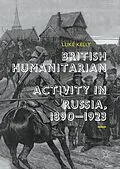
Examines the humanitarian facets of the Anglo-Russian relationship from the late nineteenth century until the mid-twenties
Focuses on the roles of Christian, Jewish and liberal interests to show how humanitarianism developed 'from below'
Considers humanitarianism in relation to broader political frameworks and ideologies
Autorentext
Luke Kelly is Lecturer in Modern British History at the University of Manchester, UK.
Klappentext
This study analyses the humanitarian facets of the Anglo-Russian relationship, something yet to be addressed in existing scholarship in a systematic way. It focuses on the humanitarian aid offered between the flowering of Russophilia in the 1880s up until Stalin's closing of the country in the mid-1920s, and seeks to show why a humanitarian discourse emerged from the Anglo-Russian relationship. A variety of activists offered aid or sympathy. This book seeks to characterise the nature of their engagement with Russia's problems, and in so doing to understand the links between humanitarianism and these non-humanitarian groups and viewpoints, thereby contributing to debates on the nature of humanitarianism by arguing against the view that it derives from a fairly neutral sympathy applied to a variety of settings. Instead, this study posits that humanitarianism is intimately connected to the ideals and interests of those who undertake it. In this case, a focus on the roles of Christian, Jewish and liberal interests in deploying humanitarian solutions shows how humanitarianism developed 'from below'. It also contextualises this humanitarian interest 'from above' in the parameters of the Anglo-Russian relationship, seeing humanitarianism in relation to the broader political frameworks and ideologies to which it contributed.
This book analyses the efforts of churches, pressure groups, charities, politicians and journalists to promote religious and political liberty and to relieve the victims of famines in late-tsarist and early communist Russia. Luke Kelly seeks to show why a humanitarian discourse emerged from the Anglo-Russian relationship, and assesses the nature of these activists' engagement with Russia's problems. By focusing on the roles of Christian, Jewish and liberal interests in deploying humanitarian solutions, Kelly shows how humanitarianism developed 'from below', while also examining the cause of these interests 'from above', through cultural exchanges and diplomacy.
Zusammenfassung
This book analyses the efforts of British civil society to help a Russia seen to be struggling between 1890 and the 1920s. Luke Kelly seeks to show why churches, pressure groups, charities, politicians and journalists came to promote religious and political liberty and to relieve the victims of famines in late-tsarist and early communist Russia. By focusing on the roles of Christian, Jewish and liberal interests in deploying humanitarian solutions, Kelly shows how humanitarianism developed 'from below', while also examining the growth of a broader humanitarian discourse in the context of the Anglo-Russian relationship.
Inhalt
1. Introduction: British Humanitarian Activity and Russia, c. 1890-1923.- 2. Humanitarian traditions and Russia's problems.- 3. Britain and the Russian Famine, 1891-2.- 4. Speaking up for Religious Freedom in Russia: Jewish and Christian humanitarianism.- 5. Humanitarian sympathy and national liberation.- 6. Britain and the Russian Famine, 1921-3.- 7. Conclusion.- Index
Titel
British Humanitarian Activity in Russia, 1890-1923
Autor
EAN
9783319651903
Format
E-Book (pdf)
Hersteller
Digitaler Kopierschutz
Wasserzeichen
Dateigrösse
3.48 MB
Anzahl Seiten
220
Unerwartete Verzögerung
Ups, ein Fehler ist aufgetreten. Bitte versuchen Sie es später noch einmal.