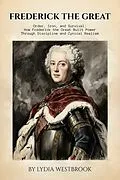
Frederick the Great did not inherit power in a position of strength. He inherited a vulnerable, exposed state surrounded by larger, richer, and more stable rivals. What followed was not a story of glory, but of survival.
In Frederick the Great, Lydia Westbrook offers a sharp and unsentimental portrait of one of Europe's most misunderstood rulers. Rejecting romantic myths, this book presents Frederick not as a heroic conqueror, but as a strategist shaped by fear, discipline, and relentless calculation. His achievement was not domination for its own sake, but the transformation of Prussia from a fragile secondary kingdom into a durable European power that could withstand constant external threat.
Through detailed analysis of his campaigns, governance, and personal psychology, the book shows how Frederick treated war as mathematics, discipline as a weapon, and the state as a machine built for endurance. Enlightenment ideals appear here not as moral commitments, but as tools used with precision and distance. His rule established a system where efficiency replaced sentiment, and order took priority over comfort.
At the center of this biography is a deeper question about power itself. How do small states survive among predators? What allows limited resources to outperform greater strength? And what is the human cost of building systems that demand absolute control?
Cold, analytical, and grounded in strategic realism, Frederick the Great is not a celebration of power, but a study of how it is built, maintained, and paid for.