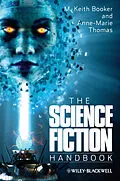
The Science Fiction Handbook offers a comprehensive and
accessible survey of one of the literary world's most fascinating
genres.
* Includes separate historical surveys of key subgenres including
time-travel narratives, post-apocalyptic and post-disaster
narratives and works of utopian and dystopian science fiction
* Each subgenre survey includes an extensive list of relevant
critical readings, recommended novels in the subgenre, and
recommended films relevant to the subgenre
* Features entries on a number of key science fiction authors and
extensive discussion of major science fiction novels or
sequences
* Writers and works include Isaac Asimov; Margaret Atwood; George
Orwell; Ursula K. Le Guin; The War of the Worlds (1898);
Starship Troopers (1959); Mars Trilogy (1993-6); and
many more
* A 'Science Fiction Glossary' completes this indispensable
Handbook
Autorentext
M. Keith Booker is the James E. and Ellen Wadley Roper Professor of English and Director of the Program in Comparative Literature and Cultural Studies at the University of Arkansas. He is the author of more than 30 books on literature, popular culture, and cultural theory.
Anne-Marie Thomas is Associate Professor of English at Austin Community College. She teaches literature and composition, including science fiction classes for the college's Honors Program.
Klappentext
Few literary genres can expand the boundaries of our imagination as much as science fiction. The Science Fiction Handbook offers a comprehensive historical survey of literary works of science fiction and its most popular sub-genres. Beginning with a broad overview of science fiction's emergence as a literary genre, the Handbook goes on to provide detailed historical surveys of its distinct sub-genres, whose development often paralleled society's technological advances. These include works of time-travel and alternative history narratives; alien-invasion narratives; space exploration and space opera; post-apocalyptic and post-disaster narratives; works of utopian and dystopian science fiction; feminism and gender themes in science fiction; science fiction as satire; cyberpunk and post-human science fiction; and multicultural science fiction. The authors also offer brief biographies of several noted science fiction writers along with extended critical analyses of 20 of the genre's most significant works.
Zusammenfassung
The Science Fiction Handbook offers a comprehensive and accessible survey of one of the literary world's most fascinating genres.
- Includes separate historical surveys of key subgenres including time-travel narratives, post-apocalyptic and post-disaster narratives and works of utopian and dystopian science fiction
- Each subgenre survey includes an extensive list of relevant critical readings, recommended novels in the subgenre, and recommended films relevant to the subgenre
- Features entries on a number of key science fiction authors and extensive discussion of major science fiction novels or sequences
- Writers and works include Isaac Asimov; Margaret Atwood; George Orwell; Ursula K. Le Guin; The War of the Worlds (1898); Starship Troopers (1959); Mars Trilogy (1993-6); and many more
- A 'Science Fiction Glossary' completes this indispensable Handbook
Inhalt
Part I: Introduction.
Science Fiction in Western Culture.
Part II: Brief Historical Surveys of Science Fiction Subgenres.
The Time-Travel Invasion.
The Alien Invasion Narrative.
The Space Opera.
Apocalyptic and Post-Disaster Narratives.
Dystopian Science Fiction.
Utopian Fiction.
Feminism, Science Fiction, and Gender.
Science Fiction and Satire.
Cyberpunk and Posthuman Science Fiction.
Multicultural Science Fiction.
Part III: Representative Science Fiction Authors.
Isaac Asimov (1920-1992).
Margaret Atwood (1939-).
Octavia Butler (1947-2006).
Samuel R. Delany (1942-).
Philip K. Dick (1928-1982).
William Gibson (1948-).
Nicola Griffith (1960-).
Joe Haldeman (1943-).
Robert A. Heinlein (1907-1988).
Nalo Hopkinson (1960-).
Ursula K. Le Guin (1929-).
Ian McDonald (1960-).
China Miéville (1972-).
George Orwell (1903-1950).
Marge Piercy (1936-).
Frederik Pohl (1919-).
Kim Stanley Robinson (1952-).
Neal Stephenson (1959-).
H. G. Wells (1866-1946).
Part IV: Discussions of Individual Texts.
H. G. Wells, The Time Machine (1895).
H. G. Wells, The War of the Worlds (1898).
George Orwell, Nineteen Eighty-Four (1949).
Isaac Asimov, I, Robot (1950).
Frederik Pohl and C. M. Kormbluth, The Space Merchants (1952).
Robert A. Heinlein, Starship Troopers (1959).
Philip K. Dick, Do Androids Dream of Electric Sheep? (1968).
Ursula K. Le Guin, The Dispossessed (1974).
Joe Haldeman, The Forever War (1974).
Marge Piercy, Woman on the Edge of Time (1976).
Samuel R. Delany, Trouble on Triton (1976).
William Gibson, Neuromancer (1984).
Margaret Atwood, The Handmaid's Tale (1985).
Octavia Butler, "Xenogenesis" trilogy (1987-1989).
Neal Stephenson, Snow Crash (1992).
Nicola Griffith, Ammonite (1994).
Kim Stanley Robinson, "Mars" trilogy (1992-1996).
Nalo Hopkinson, Midnight Robber (2000).
China Miéville, Perdido Street Station (2000).
Ian McDonald, River of Gods (2005).
Glossary.
Selected Bibliography.
Index.