Autorentext
Marshall Copeland is a cloud security architect focused on helping customers shift left with cloud security defenses in Azure public cloud using cloud-native services and third-party network security appliances. He uses Infrastructure as Code (IaC) with ARM templates or Terraform HCL to build cloud infrastructure and disaster recovery solutions. Marshall's Azure security design skills include Azure Sentinel, Security Center, Policy, Firewall and ACL networking, and a few open-source solutions such as ELK stack, Wireshark, and Snort. He partners with security operations to guide cloud investigations to enhance blue team hunting efficiencies.

Matthew Jacobs is a system engineer focused on cloud architecture technologies needed to support identity management, security, and collaboration tool sets for small and medium businesses, including enterprise organizations. His work has focused on digital transformation, including on-premise only, hybrid cloud networks, and complete public cloud-only deployment. Matthew brings a hands-on cloud architecture approach for Identity Management (IAM) and enhanced engineering to enable business agility that secures and supports a global remote work force. His current work in the Nashville, Tennessee area includes Fortune 500 media, entertainment, and hospitality companies, and his work history extends into public cloud federal compliance requirements for the banking and healthcare industries.  


Klappentext
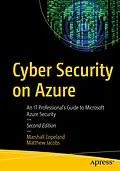
Prevent destructive attacks to your Azure public cloud infrastructure, remove vulnerabilities, and instantly report cloud security readiness. This book provides comprehensive guidance from a security insider's perspective.

Cyber Security on Azure supports cloud security operations and cloud security architects by supplying a path to clearly identify potential vulnerabilities to business assets and reduce security risk in Microsoft Azure subscription. This updated edition explores how to lean-in and recognize challenges with IaaS and PaaS for identity, networks, applications, virtual machines, databases, and data encryption to use the variety of Azure security tools. You will dive into Azure Cloud Security to guide cloud operations teams to become more security focused in many areas and laser focused on security configuration. New chapters cover Azure Kubernetes Service and Container security and you will get up and running quickly with an overview of Azure Sentinel SIEM Solution.

You will:
  • Understand enterprise privileged identity and security policies
  • "Shift left" with security controls in Microsoft Azure
  • Configure intrusion detection and alerts
  • Reduce security risks using Azure Security Service


Inhalt
Part I: Zero Trust Cloud Security 

Chapter 1. Reduce Cybersecurity Vulnerabilities from the Identity Layer  

In this chapter you learn the foundation of Azure active directory and quickly expand on the different capabilities for custom domains to manage Azure Subscriptions and why Identity is the security perimeter in the cloud. Azure directly supports IAM (Identity Access Management), for any size organization as the IT cloud supports secure connection from any device and any location. In this chapter you gain insight into IAM challenges for blue team defense of cyber security attacks.

·         Azure cloud relations to: Azure Tenant, Azure Subscription, Azure AD

o   Azure tenant security

o   Azure subscription security

o   Azure API security

o   Azure resource locks

·         Managing Azure Active Directory: Users, and Groups

·         Azure Active Directory OAuth, SAML, AD Connect

·         Security measures:

o   Azure Application Permission Scopes, consent

o   Configure Multi-Factor Authentication

o   Conditional Access Policies

·         Configure Azure AD Privileged Identity Management


Chapter 2 Azure Network Security Configuration  

Software defined network is titled VNet in Azure and introduces new security challenges for cloud security architect when it comes to isolate data and still allow secure communication from valid users, applications and systems. In this chapter you learn security supported networking in Azure with the guides to present TCP/IP, protocol communication ports and what Azure security services are available to learn about notable tactics, techniques and procedures (TTPs) that can be exploited by Advanced Persistent Threats (APT). You learn VNet recommendations to mitigate misconfigurations and provide detection on Incidents of Compromise (IOC) like forensic evidence of potential intrusions. 

·         Virtual Networks, VNets, Network Peering

·         NSG, Port vulnerability, OSI / TCP Model

·         Azure Firewall Configurations

·         Azure Front Door Service

·         Application Security Groups

·         Remote Access Management

 Chapter 3 Reduce Cybersecurity Vulnerabilities from IaaS and Data 

Operational frameworks and cyber security frameworks work hand-in-hand to support the business. The framework helps to prepare and enable steps to prevent penetration from globally attacks.  In this chapter you learn through examples about advanced persistent threats (APT) using techniques, tactics and procedures to reduce risk to specific threats.

·         Harden Azure VMs

·         VM Security

·         VM Endpoint Security

·         VM OS security updates

·         Database configurations (Best Practices)

o   Authentication

o   Auditing

o   SQL Advanced Threat Protection

·         Storag...

Titel
Cyber Security on Azure
Untertitel
An IT Professional's Guide to Microsoft Azure Security
EAN
9781484265314
Format
E-Book (pdf)
Hersteller
Digitaler Kopierschutz
Wasserzeichen
Dateigrösse
14.05 MB
Anzahl Seiten
278