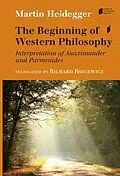
Through a close reading of two presocratic philosophers, Heidegger demonstrates that all of Western philosophy is rooted in the question of Being.
This volume comprises a lecture course given at the University of Freiburg in 1932, five years after the publication of Being and Time. During this period, Heidegger was at the height of his creative powers, which are on full display in this clear and imaginative text.
Heidegger analyses two of the earliest philosophical source documents, fragments by Greek thinkers Anaximander and Parmenides. Heidegger develops their common theme of Being and non-being and shows that the question of Being is indeed the origin of Western philosophy. His engagement with these Greek texts is as much of a return to beginnings as it is a potential reawakening of philosophical wonder and inquiry in the present.
Autorentext
Heidegger's contribution to the growth and development of National Socialism was immense. In this small anthology, Dr. Runes endeavors to point to the utter confusion Heidegger created by drawing, for political and social application of his own existentialism and metaphysics, upon the decadent and repulsive brutalization of Hitlerism.
Martin Heidegger was a philosopher most known for his contributions to German phenomenological and existential thought. Heidegger was born in rural Messkirch in 1889 to Catholic parents. While studying philosophy and mathematics at Albert-Ludwig University in Freiburg, Heidegger became the assistant for the philosopher Edmund Husserl. Influenced by Husserl, Kierkegaard, and Nietzsche, Heidegger wrote extensively on the quality of Being, including his Opus Being and Time. He served as professor of philosophy at Albert-Ludwig University and taught there during the war. In 1933, Heidegger joined the National Socialist German Worker's (or Nazi) Party and expressed his support for Hitler in several articles and speeches. After the war, his support for the Nazi party came under attack, and he was tried as a sympathizer. He was able to return to Albert Ludwig University, however, and taught there until he retired. Heidegger continued to lecture until his death in 1973.
Zusammenfassung
Volume 35 of Heidegger's Complete Works comprises a lecture course given at the University of Freiburg in 1932, five years after the publication of Being and Time. During this period, Heidegger was at the height of his creative powers, which are on full display in this clear and imaginative text. In it, Heidegger leads his students in a close reading of two of the earliest philosophical source documents, fragments by Greek thinkers Anaximander and Parmenides. Heidegger develops their common theme of Being and non-being and shows that the question of Being is indeed the origin of Western philosophy. His engagement with these Greek texts is as much of a return to beginnings as it is a potential reawakening of philosophical wonder and inquiry in the present.
Inhalt
Contents
Translator's Introduction
The beginning of Western philosophy
Interpretation of Anaximander and Parmenides
Part One
The dictum of Anaximander of Miletus, 6th-5th Century
Introduction
1. The mission and the dictum
Chapter I
The first phase of the interpretation
A. The first section of the statement
2. The theme of the dictum: beings as a whole
B. The second section of the statement
3. Beings in the relation of compliance and noncompliance
C. The third section of the statement
4. Being and time
Chapter II
The second phase of the interpretation
5. The unitary content of the pronouncement on the basis of its central core
Chapter III
The other dictum
6. The sovereign source of beings as the empowering power of appearance
Part Two
Interposed considerations
7. Four objections to the interpretation
8. The negative relation to the beginning
9. Meditation on the "current situation"
10. The grounding utterance of Being
11. The actual asking of the question of Being
12. Review of the linguistic usage
13. The basic question of existence
14. Commentary on our concept of existence
15. The full rendering of the understanding of Being
16. The liberation toward freedom
17. Transition to Parmenides: the first explicit and coherent unfolding of the question of Being
Part Three
The "didactic poem" of Parmenides of Elea
6th-5th Century
18. Introduction
19. Interpretation of fragment 1. Preparation for the question of Being
20. Interpretation of fragments 4 and 5
21. Interpretation of fragments 6 and 7
22. Interpretation of fragment 8
23. The fragments 9, 12, 13, 10, 11, 14, 16, 19 (in the order of their interpretation)
Conclusion
24. The inceptual question of Being; the law of philosophy
Appendix
Drafts and plans for the lecture course
Editor's afterword
German-English Glossary
English-German Glossary