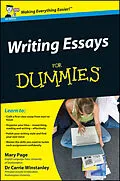
This straight-talking guide will help you develop your essay-writing skills and achieve higher marks
Do ever wish that you could write the perfect university essay? Are you left baffled about where to start? This easy-to-use guide walks you through the nuts and bolts of academic writing, helping you develop your essay-writing skills and achieve higher marks. From identifying the essay type and planning a structure, to honing your research skills, managing your time, finding an essay voice, and referencing correctly, Writing Essays For Dummies shows you how to stay on top of each stage of the essay-writing process, to help you produce a well-crafted and confident final document.
Writing Essays For Dummies covers:
Part I: Navigating a World of Information
Chapter 1: Mapping Your Way: Starting to Write Essays
Chapter 2: Identifying the essay type
Part II: Researching, Recording and Reformulating
Chapter 3: Eyes Down: Academic reading
Chapter 4: Researching Online
Chapter 5: Note-taking and Organising your Material
Chapter 6: Avoiding Plagiarism
Part III: Putting Pen to Paper
Chapter 7: Writing as a process
Chapter 8: Getting Going and Keeping Going
Part IV: Mastering Language and Style
Chapter 9: Writing with Confidence
Chapter 10: Penning the Perfect Paragraph
Chapter 11: Finding Your Voice
Part V: Tightening Your Structure and Organisation
Chapter 12: Preparing the Aperitif: The Introduction
Chapter 13: Serving the Main Course: The Essay's Body
Chapter 14: Dishing up Dessert: The Conclusion
Chapter 15: Acknowledging Sources of Information
Part VI: Finishing with a Flourish: The Final Touches
Chapter 16: It's all in the detail
Chapter 17: Perfecting Your Presentation
Chapter 18: The afterglow
Part VII: Part of Tens
Chapter 19: Ten Tips to Avoid Things Going Wrong
Chapter 20: Ten Ways to Make Your Essay Stand Out
Autorentext
Mary Page teaches English for Academic Purposes and essay-writing skills at the University of Southampton.
Dr Carrie Winstanley is a Principal lecturer in Education at Roehampton University. Carrie was recently named one of the Top 50 university teachers in the UK by the Higher Education Academy.
Klappentext
Learn to:
- Craft a first-class essay from start to finish
- Organise your time – researching, reading and writing – effectively
- Polish your writing style and find your own voice
- Master the skills you need to tackle each assignment confidently
Learn the secrets to handing in excellent essays
Good essay-writing never goes out of style – and Writing Essays For Dummies shows you how to do it. This accessible, step-by-step guide breaks the task into manageable chunks, covering everything from organising your time and gathering ideas to researching, structuring and editing an assignment. You'll soon be writing essays that stand out from the crowd – every time.
- The crucial preparation stages – get organised, get started and keep your work on track
- The nuts and bolts of the writing process – make the most of your time when you plan, read, research and take notes
- Simple steps to developing flawless style – take some grammar, add a pinch of your own voice and pen the perfect paragraph
- Beginning, middle and end – put all the elements together to craft an assignment with flair
- Sweating the small stuff – edit your English, perfect your layout and prepare for your next assignment
Open the book and find:
- How to get started and plan your time wisely
- What your tutor expects from you
- The best way to work through your reading list
- The secrets of effective note-taking
- The fundamentals of good grammar
- How to structure and shape your essay
- Tips on hitting your deadlines with time to spare
- All you need to know about referencing and plagiarism
- Where to turn if you get a lower mark than you expected
Inhalt
Introduction 1
About This book 2
Conventions Used in This Book 2
How This Book is Organised 3
Part I: Navigating a World of Information 3
Part II: Researching, Recording and Reformulating 3
Part III: Mastering Language and Style 3
Part IV: Tightening Your Structure and Organisation 4
Part V: Finishing with a Flourish: The Final Touches 4
Part VI: The Part of Tens 4
Icons Used in This Book 5
Where to Go from Here 5
Part I: Navigating a World of Information 7
Chapter 1: Mapping Your Way: Starting to Write Essays 9
Transitioning to University-level Writing 9
Writing at school 10
Writing at undergraduate level 10
Writing at postgraduate level 11
Getting the Genre Right 12
Writing an essay, not creative prose 12
Writing an essay, not a newspaper article 13
Writing an essay, not a report 15
Crafting Your Essay: Stages in the Writing Process 17
Stage 1: Analysing the title 17
Stage 2: Making a timetable 18
Stage 3: Gathering data 19
Stage 4: Brainstorming and planning 20
Stage 5: Writing the first draft 21
Stage 6: Revising your draft 22
Stage 7: Checking and polishing 22
The final hurdle: Handing in 23
Becoming a Successful Essay Writer 23
Just write, write, write 24
Giving yourself enough time 25
Changing your mindset 25
Chapter 2: Getting Going and Keeping Going 27
Getting Ready to Write 27
Finding out what helps you to work 27
Organising yourself 30
Overcoming Writer's Block 32
Challenging your fears 32
Writing something anything and rewording it 32
Talking before you write 33
Visualising the final product 34
Forgetting about the essay for a while 34
Sleeping on it 35
Reading something different 35
Getting your blood flowing 36
Doing something that makes you feel good 36
Keeping Yourself on Track 37
Planning large scale 37
Planning small scale 39
Thinking half hours not whole hours 41
Dividing work into manageable chunks 42
Rewarding yourself 42
Getting Help: Using Other Students as a Sounding Board 42
Recognising What Helps You to Write 44
Chapter 3: Working Out the Essay Type 45
Finding Out What to Write About 46
Unpicking keywords 46
Looking for function words 47
Identifying Different Frameworks 51
Knowing what you do for all frameworks 52
Examining types of essay 53
Making your story flow 61
Planning Around Your Framework 61
Part II: Researching, Recording and Reformulating 63
Chapter 4: Eyes Down: Academic Reading 65
Reading Academically: How It Differs 66
Using Your Reading List 67
Knowing which books to read 67
Finding the books on your list 68
Moving Beyond the Reading List: Searching for Literature 70
Using the library catalogue 70
Calling on the experts 71
Using Articles from Journals 72
Brushing Up Your Reading Techniques 75
Reading smartly 75
Reading online 78
Reading faster 79
Putting it all together: The SQ3R technique 82
Reading critically 83
Chapter 5: Researching Online 85
Exercising Caution as You Surf 85
Getting Started: Using Popular Websites 86
Checking …