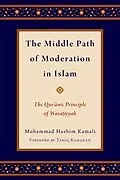
Winner of the I.R. Iran World Award for Book of the Year In The Middle Path of Moderation in Islam, leading Islamic law expert Mohammad Hashim Kamali examines the concept of wasatiyyah, or moderation, arguing that scholars, religious communities, and policy circles alike must have access to this governing principle that drives the silent majority of Muslims, rather than focusing on the extremist fringe. Kamali explores wasatiyyah in both historical/conceptual terms and in contemporary/practical terms. Tracing the definition and scope of the concept from the foundational sources of Islam, the Qu'ran and Hadith, he demonstrates that wasatiyyah has a long and well-developed history in Islamic law and applies the concept to contemporary issues of global policy, such as justice, women's rights, environmental and financial balance, and globalization. Framing his work as an open dialogue against a now-decades long formulation of the arguably destructive Huntingtonian "clash of civilizations" thesis as well as the public rhetoric of fear of Muslim extremism since the attacks of September 11, 2001, Kamali connects historical conceptions of wasatiyyah to the themes of state and international law, governance, and cultural maladies in the Muslim world and beyond. Both a descriptive and prescriptive meditation on a key but often neglected principle of Islam, The Middle Path of Moderation in Islam provides insight into an idea that is in the strategic interest of the West both to show and practice for themselves and to recognize in Muslim countries.
Autorentext
Mohammad Hashim Kamali was Dean and Professor at the International Institute of Islamic Thought and Civilization (ISTAC) and the International Islamic University in Malaysia. He currently heads the International Institute of Advanced Islamic Studies (IAIS) Malaysia. Tariq Ramadan is Professor of Contemporary Islamic Studies at Oxford University (Oriental Institute, St. Antony's College).
Zusammenfassung
Winner of the I.R. Iran World Award for Book of the YearIn The Middle Path of Moderation in Islam, leading Islamic law expert Mohammad Hashim Kamali examines the concept of wasatiyyah, or moderation, arguing that scholars, religious communities, and policy circles alike must have access to this governing principle that drives the silent majority of Muslims, rather than focusing on the extremist fringe. Kamali explores wasatiyyah in both historical/conceptual terms and in contemporary/practical terms. Tracing the definition and scope of the concept from the foundational sources of Islam, the Qu'ran and Hadith, he demonstrates that wasatiyyah has a long and well-developed history in Islamic law and applies the concept to contemporary issues of global policy, such as justice, women's rights, environmental and financial balance, and globalization. Framing his work as an open dialogue against a now-decades long formulation of the arguably destructive Huntingtonian "e;clash of civilizations"e; thesis as well as the public rhetoric of fear of Muslim extremism since the attacks of September 11, 2001, Kamali connects historical conceptions of wasatiyyah to the themes of state and international law, governance, and cultural maladies in the Muslim world and beyond. Both a descriptive and prescriptive meditation on a key but often neglected principle of Islam, The Middle Path of Moderation in Islam provides insight into an idea that is in the strategic interest of the West both to show and practice for themselves and to recognize in Muslim countries.
Inhalt
Foreword I. Introduction Part One: Conceptual Analysis II. Definition and Scope of Wasatiyyah III. Review of the Source Evidence IV. A Round-up of Modern Opinion V. Hallmarks of Extremism VI. Manifestations of Wasatiyyah VII. Identification of Wasatiyyah VIII. Institutional Developments Part Two: Thematic Perspectives IX. Moderation and Justice X. Moderation in Religiosity XI. The Moderating Role of Ikhtilaf (Reasoned Disagreement) XII. Between Spirituality and Legalism: The Moderating Influence of Sufism XIII. Harm (Darar) Must Be Eliminated XIV. Forbearance, Bringing Ease and Removing Hardship XV. Environmental Imbalance XVI. Financial Imbalance, Extravagance and Waste XVII. Moderation in Jihad XVIII. Character and Lifestyle XIX. Wasatiyyah and Women's Rights XX. Wasatiyyah and Globalisation XXI. Islam between Antiquity and the Modern World XXII. Continuity and Change: An Analysis of Tajdid and Islah (Renewal and Reform) in Islam XXIII. Conclusion and Recommendations Glossary Bibliography Index of Qur'anic Verses and Hadith General Index