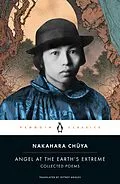
The intensely confessional work of Japan's most famous modernist poet, considered the Japanese Rimbaud, whose poems have inspired cultlike devotion-especially among fans of the hit anime show Bungo Stray Dogs-in a brilliant new translation, the most comprehensive in English
A Penguin Classic
Nakahara Chuya lived only to age thirty yet ranks among the finest of Japanese poets, evoking in his work the alienation, ennui, and romantic melancholy of a changing world. An introspective, sensitive writer and early-twentieth-century contemporary of Natsume Soseki, Jun'ichiro Tanizaki, and Osamu Dazai, he chronicled in his poems a life of personal and political upheaval: His lover left him for his most trusted friend, his first son died at age two, his country hovered on the precipice of war, and his own tremendous promise was cut short by illness.
This edition is by far the largest collection in English of Chuya's poetry, containing unabridged translations of the two books Chuya completed in his lifetime--Songs of the Goat and Songs of Days That Were--plus nearly one hundred additional pages of his traditional Japanse tanka poems, uncollected poems, and various other manuscripts, as well as an extensive scholarly introduction that situates Chuya within his historical moment. It captures in a melodic new translation the beauty and intimacy of this beloved poet's voice, showing why it has resonated with readers for a century.
Penguin Classics is the leading publisher of classic literature in the English-speaking world, representing a global bookshelf of the best works throughout history and across genres and disciplines. Readers trust the series to provide authoritative texts enhanced by introductions and notes by distinguished scholars and contemporary authors, as well as up-to-date translations by award-winning translators.
Autorentext
Nakahara Chuya (1907-1937) was one of the finest Japanese poets of the twentieth century. Often referred to as the Japanese Rimbaud for his tragic early death and poems of ennui and romantic melancholy, he was a pioneer of modernism in Japanese poetry and published two collections in his lifetime, Songs of the Goat and Songs of Days That Were.
Jeffrey Angles (editor/translator) is a poet, translator, and professor of Japanese literature at Western Michigan University. He has won awards for his translations from the National Endowment for the Arts, the Academy of American Poets, the Poetry Foundation, the Modern Language Association, PEN America, and the Donald Keene Center of Japanese Culture at Columbia University. His own book of Japanese poetry was a finalist for the Nakahara Chuya Prize and won the Yomiuri Prize.