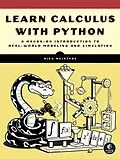
See calculus in action with Python, visualization, and real-world applications. The world around us is being designed and built using calculus. It's a beautiful subject that makes more sense when you can see what it does. Learn Calculus with Python turns calculus into something you can experiment with. You'll begin by programming a virtual turtle, and as you shrink its steps you'll arrive at limits, derivatives, integrals, and finally the fundamental theorem of calculus. Along the way, you'll write a graphing calculator, watch integrals accumulate area, and move objects through space using differential equations. The code lets you see the math at work. You'll use calculus and the book's interactive Jupyter Notebook coding environment to:
- Measure income inequality with an integral
- Simulate gravity and send two bodies into orbit
- Plot the Lorenz system to watch chaos emerge in the atmosphere
- Train a neuron using backpropagation and gradient descent
- Break an audio signal into its frequencies with the fast Fourier transform
Autorentext
Nick McIntyre teaches high school mathematics, physics, robotics, and computer science in Texas. His passion projects range from high-tech art installations to a real-time flood reporting system built during Hurricane Harvey. He's also worked to make programming and STEM education more accessible through projects with the Processing Foundation and Google Summer of Code.