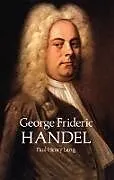
"I was so impressed by what Dr. Lang has done in his new and very fresh approach to Handel, his life and works, that I can find only one word to express my feeling about it: Monumental!" ? Eugene Ormandy.
Universally known and admired for his great oratorio Messiah, George Frideric Handel (1695?1759) ranks among the greatest composers of all time. Over a career of more than 50 years, most of it spent in England, the German-born master composed numerous other oratorios, operas, concertos, chamber music, orchestral suites, cantatas, and more. But until now, far less has been known about the man "possessed of a central calm" but whose "driving force was incalculable."
In this immensely thorough and readable biography ? considered by many scholars the definitive work on Handel ? renowned musicologist Paul Henry Lang penetrates the mystery of Handel's life to paint a vivid portrait of the great composer, while offering expert analysis of Handel's music ? its sources, nature, forms, and influence.
Detailed, meticulously researched discussions cover Handel's birth and childhood in Halle; his early musical training and years at university; sojourns in Italy and meetings with Corelli, Scarlatti, and other major composers; Handel's adoption of England as his home; his business dealings in London; his somewhat puzzling relations with women; the onset of blindness in 1751 and the end of his artistic career; his death in 1759 and burial in Westminster Abbey; and many other aspects of his long and complex life.
In addition to the breadth of biographical material, Dr. Lang offers detailed discussions of Handel's music, of both its general characteristics and the specific features of such masterworks as the oratorios Messiah, Israel in Egypt, Solomon and Judas Maccabaeus; the operas Giulio Cesare and Rinaldo; the orchestral suites Royal Fireworks Music and Water Music;the pastoral Acis and Galatea; the odes Alexander's Feast and Ode for St. Cecilia's Day; and many other compositions. Perceptive, extremely thorough and obviously a labor of love, this masterly biography belongs in the library of every musician, music lover, and student of music and music history.
FOREWORD INTRODUCTION Halle -Handel's family -Earliest youth -Apprenticed to Zachow -Zachow as teacher -Handel's notebook and its contents -Fellow students -Visit to BerlinMeeting electoral couple and Italian composers -Appointed organist at Halle Cathedral-The university student -Compositions in Halle period -Decision to leave Halle --Hamburg -Music in Hamburg -Handel arrives in 1703 -Friendship with Mattheson -Handel joins opera orchestra -Keiser, his influence on HandelFirst attempt at opera, Almira (1705) -Handel-Keiser relationship -Altercation and reconciliation with Mattheson -Debacle of Nero -Handel resigns from Hamburg opera -Composes St. John Passion -State of oratorio-Passion in Germany -The Passion in Handel's life work -Handel leaves for Italy --Italy at the opening of the 18th century -Hegemony of opera and concertoGerman vs. Italian music -The process of assimilation -Handel in FlorenceRome -Papal court, academies, patrons -Prohibition of opera -The Arcadian Academy -Handel meets Corelli, Scarlatti, Pasquini -Begins his study of Italian music -The cantata -Mood and melody -The Florentine cantatas -Roman cantatas -Handel's patrons -Large cantata-serenatas -Church music -Spirit of Latin-Italian church music -The "bilingual" composers -Survival of Palestrina ideal-Maturing of Handel's choral writing IV (-1710) The Italian oratorio -Dramatic-theatrical elements -Role of the ScripturesCarissimi -The Old Testament in thc Italian oratorio -Italian works heard by Handel-La Resurrezione (1708) -Second visit to Florence -Rodrigo Naples -Opera and church music in Naples -Composes Ad, Galatea, e Polifemo and Agrippina -Venice -Agrippina produced December 1709Friendship with Domenico Scarlatti -Musical life in Venice -OperaConservatories -The late Venetian madrigal-Instrumental music -Italian musical language completely absorbed -Aspects of Handel's decision to abandon Italy -Religious and artistic reasons -Handel leaves for Hanover --Hanover -Elector Georg Ludwig -His wife, Caroline -Brief stay in HanoverConjectures concerning voyage to London -Visit to Halle and Dusseldorf -Arrival in London, fall of 1710 -State of Italian opera in London -Entrepreneurs on the scene -The Haymarket and Drury Lane Theatres -Handel makes contact with Haymarket Theatre -The intermediaries -Handel's first London opera, Rinaldo (February 1711) -John Walsh, the publisher-Opposition to Italian opera -Handel begins to move in social circles -Thomas Britton and his concerts -Handel's leave of absence ends -Second stay in Hanover -Back in London, fall of 1712 -Compositions in Hanover VI (1712-1720) Handel in Burlington House -II Pastor fida -Tesea (1713) -First financial crisis -Birthday Ode and Utrecht Te Deum (1713) -Handel assumes Purcell's legacy -The English tone appears in Handel's music -Queen Anne dies, Georg Ludwig proclaimed King, August 1714 -George I arrives in LondonTruant Hanoverian conductor's dilemma -Handel composes Silla for Burlington, Amadigi for Haymarket (1715) -Handel firmly in saddle -Begins his financial investments -Jacobite rebellion put down -The King leaves for Hanover followed by Handel-Travels to Halle and Ansbach -Meeting Christoph Schmidt -Disputed visit to Hamburg -The German Passion in the 18th century -Brackes Passion (1716?) -Handel returns to London, end of 1716-Opera season of 1717 -Cannons -The Duke of Chandos and his establishment -The "English" compositions -Handel's sister Dorothea dies (summer of 1718)Water Music, Concertos, Opus 3 -Formation of Royal Academy of MusicHandel goes to the Continent to recruit a troupe, June 1719 -Returns late in fall -Academy ready to open
VII Baroque opera, its nature, dramaturgy, and esthetics -Comparison of Baroque with modern opera -Obstacles to our understanding -The aria -Role of Alessandro Scarlatti -Italian melody, Handelian melody -General form of Handel's opera -The castrato 174 Royal Academy opens first season -Radamisto (1720) -Giovanni Bononcini joins staff -Ensuing rivalry -Second season -Third season -Flaridante (1721) -Cuzzoni added to company -Fourth season -OUone, Flavia (1723) -Fifth season -Giulio Cesare (1724) -Bononcini vanquished -Sixth season Tamerlano, Rodelinda (1724) -Handel buys a house -Academy in financial difficulties -Bordoni engaged -Seventh season -Scipione, Alessandro (1726)Eighth season -Admeto (1727) -Profitable year -Handel becomes a British subject, February 20, 1727 -George I dies, George II proclaimed King, January 1727-Ninth season-Riccardo 1(1727), Siroe (1728) -Collapse of AcademyReasons for failure of Italian opera -"English opera" and "semi-opera" -The language barrier -The Beggar's Opera -Its success seals fate of Academy
IX Beginnings of "English" Handel-Standards of Augustan Age -Class society and religion -Capitalism -The bourgeoisie -Literature -The Burlington circle -Its influence on Handel-About church music -German music of the Baroque -The cantor's art -The Church of England -Its secular spirit in Handel's time -Nonconformists and Puritans -Handel's conception of Anglican church music -Commemorative-ceremonial-patriotic compositions -Ode and anthemChandos Anthems -Other anthems -Te Deums -Handel's English church music compared to Continental-His indebtedness to English composers Handel and Heidegger take over defunct Academy -Trip to Italy to recruit singers -Finds Italian opera changed -Aged mother's illness hastens departureVisit to Halle -Return to London -Second Academy opens, end of 1729Lotario (1729), Partenope (…