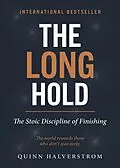
What if greatness isn't about talent, but about your willingness to keep going when the work turns dull, slow, and thankless?
We are told to find our passion, follow our dreams, and wait for the breakthrough moment. But real achievement almost never works that way. In The Long Hold, philosopher Quinn Halverstrom braids the ancient wisdom of the Stoics together with modern research on grit, deliberate practice, and hope to reveal the one thing that truly separates those who finish from those who quit.
Drawing on figures from Marcus Aurelius to Michael Jordan, Grandma Moses to Colonel Sanders, this is a bracing, honest guide to the discipline of endurance-and, just as importantly, the wisdom to know when letting go is the braver choice.
Inside, you'll discover:
- Why the myth of natural talent quietly sabotages your persistence-and what actually builds mastery
- How to turn a passing interest into durable purpose that survives boredom and setbacks
- The architecture of deliberate effort: routines and rituals that outlast fleeting motivation
- How to sustain practice past the plateau, when progress becomes invisible
- Why hope is a trainable skill, not a feeling, and how to rewrite the stories you tell yourself about failure
- The grit trap-and how to tell wise persistence apart from destructive stubbornness
Excellence is not a secret key handed to the gifted few. It belongs to those willing to hold on long enough to open a very heavy door.
Autorentext
Quinn Halverstrom is an American philosopher who applies the practical ethics of ancient thinkers to the realities of modern life-career, decision-making, and one's relationship with risk and time. He received a classical education, double-majoring in philosophy and history at a leading American university, and earned a doctorate in ancient philosophy. For roughly twelve years he worked in academia, specializing in the Stoic tradition and its application to the ethics of decision-making, before shifting toward independent writing and a closed advisory practice-having noticed that the greatest demand for philosophy comes not from lecture halls but from working executives and entrepreneurs. Out of decades of reading primary sources and advising living clients, he developed his own "School of Clear Action," a discipline of thinking that teaches people to separate what is within their power from what is not, and to translate every decision out of the fog of emotion into one clear action. Today he runs an independent author's practice, mentors entrepreneurs and executives, and leads small reading groups. He writes short, dense books in which the applied principles of the ancient philosophers meet modern stories and real decision scenarios.