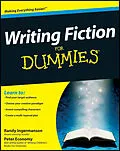
A complete guide to writing and selling your novel
So you want to write a novel? Great! That's a worthy goal, no matter what your reason. But don't settle for just writing a novel. Aim high. Write a novel that you intend to sell to a publisher. Writing Fiction for Dummies is a complete guide designed to coach you every step along the path from beginning writer to royalty-earning author. Here are some things you'll learn in Writing Fiction for Dummies:
- Strategic Planning: Pinpoint where you are on the roadmap to publication; discover what every reader desperately wants from a story; home in on a marketable category; choose from among the four most common creative styles; and learn the self-management methods of professional writers.
- Writing Powerful Fiction: Construct a story world that rings true; create believable, unpredictable characters; build a strong plot with all six layers of complexity of a modern novel; and infuse it all with a strong theme.
- Self-Editing Your Novel: Psychoanalyze your characters to bring them fully to life; edit your story structure from the top down; fix broken scenes; and polish your action and dialogue.
- Finding An Agent and Getting Published: Write a query letter, a synopsis, and a proposal; pitch your work to agents and editors without fear.
Writing Fiction For Dummies takes you from being a writer to being an author. It can happen-if you have the talent and persistence to do what you need to do.
Autorentext
Randy Ingermanson is the award-winning author of six novels. He is known around the world as "the Snowflake Guy," thanks to his Web site article on the Snowflake method, which has been viewed more than a million times. Before venturing into fiction, Randy earned a Ph.D. in theoretical physics from the University of California at Berkeley. Randy has taught fiction at numerous writing conferences and sits on the advisory board of American Christian Fiction Writers. He also publishes the world's largest e-zine on how to write fiction, The Advanced Fiction Writing E-zine. Randy's first two novels won Christy awards, and his second novel Oxygen, coauthored with John B. Olson, earned a spot on the New York Public Library's Books for the Teen Age list. Visit Randy's personal Web site at www.ingermanson.com and his Web site for fiction writers at www.AdvancedFictionWriting.com.
Peter Economy of La Jolla, California, is a bestselling author with 11 For Dummies titles under his belt, including two second editions and one third edition. Peter is coauthor of Writing Children's Books For Dummies, Home-Based Business For Dummies, Consulting For Dummies, Why Aren't You Your Own Boss?, The Management Bible, and many more books. Peter also serves as Associate Editor of Leader to Leader, the Apex Award-winning journal of the Leader to Leader Institute. Check out Peter's Web site at www.petereconomy.com.
Inhalt
Introduction 1
About This Book 1
Conventions Used In This Book 2
What You're Not to Read 2
Foolish Assumptions 3
How This Book is Organized 3
Part I: Getting Ready to Write Fiction 4
Part II: Creating Compelling Fiction 4
Part III: Editing and Polishing Your Story and Characters 4
Part IV: Getting Published 4
Part V: The Part of Tens 5
Icons Used in This Book 5
Where to Go from Here 5
Part I: Getting Ready to Write Fiction 7
Chapter 1: Fiction Writing Basics 9
Setting Your Ultimate Goal as a Writer 11
Pinpointing Where You are as a Writer 13
Freshmen: Concentrating on craft 13
Sophomores: Tackling the proposal 14
Juniors: Perfecting their pitches 15
Seniors: Preparing to become authors 16
Getting Yourself Organized 17
Mastering Characterization, Plotting, and Other Skills 18
Editing Your Fiction 18
Chapter 2: What Makes a Great Story? 21
Choosing What to Give Your Readers 22
Creating a powerful emotional experience: What your readers desperately want 22
Educating your reader 23
Practicing the gentle art of persuasion 24
Making Life Hard on Your Characters: Conflict Plus Change Equals Story 25
The Five Pillars of Fiction 26
Setting the stage: Your story world 27
Creating characters 28
Constructing the plot 28
Formulating a theme 30
Expressing your style 31
Seven Ways to Deliver the Goods 31
The here and now: Action 32
Giving your characters a voice: Dialogue 33
Revealing thoughts: Interior monologue 33
Feeling with your character: Interior emotion 34
Seeing what your character sees: Description 34
Taking a trip to the past: Flashback 35
Supplying narrative summary 35
Chapter 3: Finding Your Audience and Category 37
Identifying Your Ideal Novel 38
Looking at what you love to read 38
Thinking about what you love to write 39
Defining Your Ideal Reader 40
Considering worldview and interests 41
Looking at gender 42
Writing for readers of a certain age 43
Defining your niche 43
Understanding Your Category 43
Genres: Surveying categories based on content 45
Understanding audience-based categories 50
Picking your category and subcategory 52
Finding Your Category's Requirements 53
Targeting your word count 54
Accounting for major characters 54
Determining levels of action, romance, and all that 55
Identifying your story's emotional driver 58
Chapter 4: Four Ways to Write a Great Novel 59
Giving Yourself Permission to Write Badly 59
Creative Paradigms: Investigating Various Writing Methods 61
Writing without planning or editing 61
Editing as you go 62
Planning a little, writing a little 63
Outlining before you write 64
Finding a Creative Paradigm that Works for You 65
Understanding why method matters 66
Developing your creative paradigm 67
Using Your Creative Paradigm to Find Your Story Structure 69
Chapter 5: Managing Your Time and Yourself 71
Finding Time to Write 71
Establishing and sticking to a writing goal - for this week and this year 72
Organizing your time 74
Setting Up Your Ideal Writing Space 75
Securing the best writing surface 76
Finding the right chair 76
Choosing a computer (if you want to use one) 77
Putting everything in place 78
Dealing with Distractions 79
Looking at Money Matters 80
Budgeting money for writing 81
Making your living as a writer: Don't expect this to be your day job (yet) 82
Part II: Creating Compelling Fiction 85
Chapter 6: Building Your Story World: The Setting for Your Story 87
Identifying the Parts of a Story World 88
Creating a Sense of Place 89
Making description do double duty 90
Fitting description in the story 91
Weaving emotive force into your descriptions 92
Deciding What Drives Your Cultural Groups 93
Revealing cultural drivers with immediate scene 93
Exposition: Explaining cultural drivers through narrative summary 94
Combining various elements to show cultural drivers 95
Choosing the Backdrop for Conflict 95
Defining your backdrop 95
Defining your story question 98
Story World Examples from Four Well-Known Novels 98
Pride and Prejudice 98
The Pillars of the Earth 99
Patriot Games 100
Ender's Game101
Researching Your Sto…