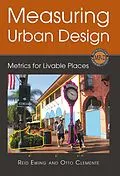
What makes strolling down a particular street enjoyable? The authors of Measuring Urban Design argue it's not an idle question. Inviting streets are the centerpiece of thriving, sustainable communities, but it can be difficult to pinpoint the precise design elements that make an area appealing. This accessible guide removes the mystery, providing clear methods to measure urban design. In recent years, many "walking audit instruments" have been developed to measure qualities like building height, block length, and sidewalk width. But while easily quantifiable, these physical features do not fully capture the experience of walking down a street. In contrast, this book addresses broad perceptions of street environments. It provides operational definitions and measurement protocols of five intangible qualities of urban design, specifically imageability, visual enclosure, human scale, transparency, and complexity. The result is a reliable field survey instrument grounded in constructs from architecture, urban design, and planning. Readers will also find a case study applying the instrument to 588 streets in New York City, which shows that it can be used effectively to measure the built environment's impact on social, psychological, and physical well-being. Finally, readers will find illustrated, step-by-step instructions to use the instrument and a scoring sheet for easy calculation of urban design quality scores. For the first time, researchers, designers, planners, and lay people have an empirically tested tool to measure those elusive qualities that make us want to take a stroll. Urban policymakers and planners as well as students in urban policy, design, and environmental health will find the tools and methods in Measuring Urban Design especially useful.
Autorentext
Reid Ewing (author of Best Development Practices, Planners Press and Growing Cooler, ULI) is a professor of City & Metropolitan Planning at the University of Utah, associate editor of the Journal of the American Planning Association, columnist for Planning magazine, Fellow of the Urban Land Institute, and member of the U.S. Green Building Council's LEED LP-Technical Advisory Group.
Otto Clemente is a senior transportation planner in Fairfax County, VA.
Inhalt
Acknowledgments
ONE Introduction
Why You Should Read This Book
Initial Screening of Qualities
Map of the Book
TWO Data Collection
Expert Panel
Videotaping
Library of Video Clips and Sample
Visual Assessment Survey
THREE Analysis and Final Steps
Walkability in Relation to Urban Design Qualities
Inter-Rater Reliability of Scene Ratings
Analyzing the Content of Sampled Scenes
Inter-Rater Reliability of Content Analysis
Urban Design Ratings in Relation to Physical Features
Cross-Classified Random Effects Models
Results of Statistical Analysis
Final Steps
FOUR Urban Design Qualities for New York City
Kathryn M. Neckerman, Marnie Purciel-Hill, James W. Quinn, and Andrew Rundle
Background
Neighborhood Characteristics and Urban Design
Methods
Results
New Strategies for Measuring Urban Design
Conclusions
FIVE Validation of Measures
Data
Measures
D Variables
Analysis
Results
Discussion
SIX Field Manual
Getting Started
Urban Design Quality Definitions
Measurement Instructions
Appendix 1: Biosketches of Expert Panel Members
Appendix 2: Operational Definitions of Physical Features
Appendix 3: Urban Design Qualities and Physical Features
Appendix 4: Scoring Sheet Measuring Urban Design Qualities
References
Index.